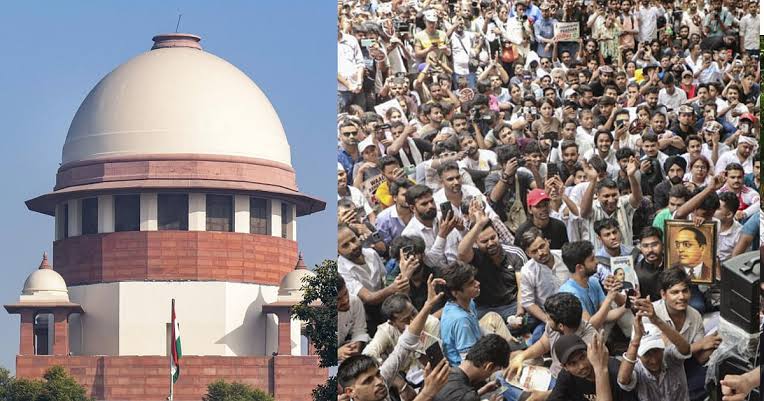
The Supreme Court on Thursday directed the Delhi government to ensure medical treatment for protesters who were injured during the July 20 demonstration in the national capital, including those who allegedly sustained pellet gun injuries.
A Bench headed by Chief Justice of India Surya Kant, along with Justices Joymalya Bagchi and V. Mohana, issued the direction while hearing petitions related to the police action during the Jantar Mantar protest. The court instructed the National Capital Territory (NCT) government to provide appropriate medical care to the injured individuals.
According to legal news portal Bar and Bench, the court directed, “Government of Delhi shall provide medical treatment to the injured petitioner or other similarly placed individuals.”
Petition Seeks Ban on Pellet Guns
The direction came during the hearing of a petition filed by former Intelligence Bureau Special Director and former Central Information Commissioner Yashovardhan Azad. The petition sought a ban on the use of pellet guns and other metallic kinetic projectiles for crowd control, besides compensation for those injured during the July 20 protest.
The petitioner urged the court to prohibit the use of pump action rifles and projectile action guns against civilian gatherings and demonstrations.
Court Suggests Challenge to Existing Rules
During the proceedings, the Bench observed that the use of pellet guns is currently permitted under existing police rules in exceptional situations. The judges noted that unless those rules are challenged, the use of such equipment cannot automatically be declared unlawful.
Justice Joymalya Bagchi observed that police regulations permit pellet guns as part of a graded response in exceptional circumstances. He indicated that if concerns relate to excessive use of force, the legal challenge should focus on the governing rules rather than the equipment alone.
Chief Justice Surya Kant also suggested that the petitioners could seek judicial guidelines governing the protocol for the use of pellet guns if allegations of excessive force are substantiated.
Court Reiterates Balance Between Protest Rights and Law Enforcement
Earlier this week, the Supreme Court emphasised that the constitutional right to peaceful protest must be protected while also stating that violence during demonstrations and excessive use of force by law enforcement are both unacceptable.
The court has been hearing multiple petitions arising from the July 20 protest and the subsequent police action.
Political Row Continues
The issue has also triggered a political debate. The Centre has maintained that pellet guns were not used during the operation and has stated that only tear gas was deployed to disperse protesters.
However, Leader of Opposition Rahul Gandhi has alleged that protesters suffered pellet-related injuries and accused Union Home Minister Amit Shah of authorising the use of force. The Bharatiya Janata Party (BJP) has rejected the allegations and demanded that Gandhi withdraw his remarks.
The controversy over the police response continues to draw legal and political attention, while the Supreme Court’s latest order focuses on ensuring medical care for those who were injured during the protest.