Imagine diagnosing one of the world’s most devastating brain diseases with nothing more sophisticated than a drop of blood and the phone already in your pocket. That future moved a big step closer today, thanks to a team of Indian scientists.
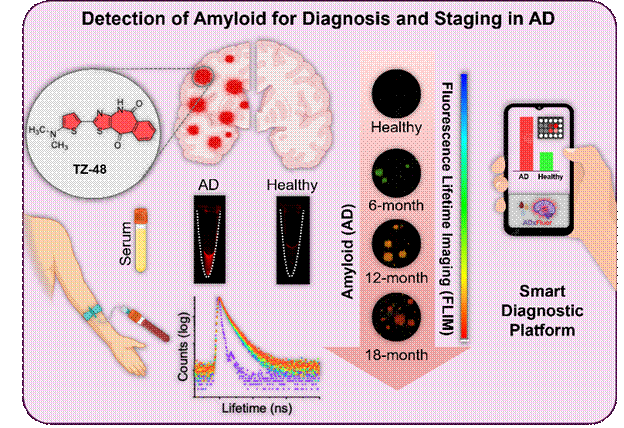
Researchers at the Jawaharlal Nehru Centre for Advanced Scientific Research (JNCASR), an autonomous institute under the Department of Science and Technology, have created a fluorescent “tiny molecule” called TZ-48 that lights up when it meets amyloid-β (Aβ) — the sticky protein clumps that are the earliest hallmark of Alzheimer’s disease (AD). Pair it with a custom smartphone app named ADxFluor, and suddenly a complex biomarker becomes measurable in minutes, at a fraction of the cost of current methods.
Alzheimer’s slowly steals memory, thinking ability and independence. By the time symptoms appear, the damage is often advanced. Doctors have long known that amyloid-β plaques start forming years earlier, yet detecting them has required expensive PET scans, specialised MRI, or complicated laboratory blood tests that remain out of reach for most people.
TZ-48 changes the equation. When the molecule binds to Aβ fibrils, its fluorescence intensity and lifetime shift in a distinctive way. These changes can be captured by ordinary smartphone cameras and analysed by the ADxFluor app, giving a clear, quantitative reading of Aβ levels. In laboratory and animal studies the probe crossed the blood-brain barrier, brightly labelled plaques in the brains of transgenic AD mice, and accurately distinguished diseased animals from healthy ones using both cerebrospinal fluid and blood serum.
The same molecule works with advanced microscopy techniques such as confocal imaging and fluorescence lifetime imaging, allowing researchers to map plaque burden across different stages of the disease. But the real translational leap is the smartphone platform. By combining dual-mode brain imaging, biofluid detection and portable quantification, the system lays the foundation for a true point-of-care diagnostic that could one day be used in primary clinics, rural health centres or even at home.
“This is not just another laboratory probe,” the research team notes. “It is a complete, scalable platform that moves Alzheimer’s detection from high-end hospitals toward everyday accessibility.”
The work, published in the journal *ACS Chemical Neuroscience*, was led by scientists including Krithi K. Bhagavath, Madhu Ramesh, Yogendra Kumar, Sabyasachi Mandal, Hiriyakkanavar Ila and Thimmaiah Govindaraju.
While further clinical validation in humans is still needed, the technology already addresses the three biggest barriers to early AD diagnosis: cost, complexity and access. In a country where millions are expected to develop dementia in the coming decades, a simple, affordable test that flags risk years before symptoms appear could prove transformative — not only for patients and families, but for healthcare systems struggling under the growing burden of neurodegenerative disease.
The age of smartphone medicine has arrived for Alzheimer’s. And this time, the innovation is proudly Made in India.