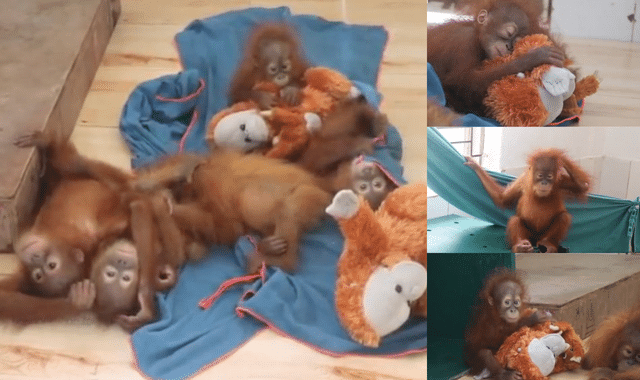
They are barely a year old, far from the rainforests of Borneo and Sumatra, and now at the centre of one of Odisha’s most closely watched wildlife stories. Five infant orangutans — three males and two females — rescued from a casuarina forest in Baleshwar’s Bhograi block on September 8 are under round-the-clock care at Nandankanan Zoological Park. On Tuesday, a technical committee formed by the Principal Chief Conservator of Forests (Wildlife) entered their quarantine zone under strict biosecurity rules to see how they are coping.
The visit was not a photo opportunity. Committee members followed biosecurity protocol, entered the quarantine area, examined all five infants at close range, and studied the Hand Rearing Centre’s arrangements — from feeding and hygiene to the animals’ behaviour and health. Officials said the panel will return for further inspections and discussions, and is expected to file its observations after Wednesday. Future decisions on housing, enrichment and long-term management will rest on that report.
The committee was created precisely because these animals are not native to India and need specialised care. It includes a veterinarian from Sri Chamarajendra Zoological Gardens, Mysuru; a representative of the Wildlife Institute of India, Dehradun; the Project Coordinator of the Centre for Wildlife Health at OUAT, Bhubaneswar; a veterinarian nominated by the National Zoological Park, New Delhi; and the Director of Nandankanan as member-convener. Its tenure is six months, extendable if needed.
Quarantine views_ Getting comfortable with new home.#Nandankanan#Orangutan@ForestDeptt@SecyChief@_anugarg@Bhaskar__Sarma @PCCFWL_Odisha pic.twitter.com/cXw6AhfhVc
— NANDANKANAN ZOOLOGICAL PARK (@ddnandankanan) September 15, 2026
The infant who will not stay well
One baby — a female, according to the zoo’s earlier health bulletin — has been the source of constant anxiety. Fever has come and gone since the infants arrived. Medication brings the temperature down; then it rises again. Zoo doctors remain on alert. Deputy Director Pradeep Mirase said the sick infant is under special treatment and continuous watch. Mosquito nets have been fixed around the isolation room so that insects cannot enter. Thermal cameras now record body temperature of all five animals without unnecessary handling.
In one detailed bulletin shared by authorities, readings included about 97.2°F and 4.78 kg for one male; 99.5°F and 3.44 kg for a second male; 99.3°F and 2.84 kg for a third; 101°F for the feverish female; and 98.2°F and 2.6 kg for the other female. Later official updates on Tuesday suggested temperatures had moved closer to a normal range and that feeding had improved — but the earlier pattern of relapse is why the medical team has not relaxed. Diet change after rescue also caused gas and indigestion. Appetite and playfulness dropped. Keepers therefore shifted feeding from every two hours to every three hours and added digestive support. Every infant now receives individual attention covering medicine, food, nutrition and environment.
These babies were separated from their mothers. That fact hangs over every decision. Soft toys, swings and music have been introduced to lower stress. Officials say the first priority is not display or repatriation talk — it is keeping them alive and calmer.
A forest-like room, if the experts agree
Nandankanan is already planning the next step: intermittent access to an open enclosure next to the Hand Rearing Centre, designed to feel more like forest and less like a glass box. The idea is to increase movement, reduce anxiety and help the infants adapt. They would still remain in quarantine; visitors would still be kept away. Nothing moves until the technical committee gives the go-ahead.
The other story: two men who vanished
While veterinarians watch temperature charts, investigators are asking a harder question: where did Jayant Maiti and his son Soumyadeep Maiti go? The Odisha Police Special Task Force has linked the Digha hotel owner and his son to the suspected trafficking trail — a black SUV, hotel CCTV, and the sudden dumping of five infant orangutans in a coastal forest that is not their habitat. Raids have been conducted; family members have been questioned; the father and son remain absconding. Officials say their arrest could blow the lid off a wider smuggling network. Until then, five small primates — far from home, one of them still fighting fever — are the only witnesses the public can see.
The committee’s report will decide the next medical and housing steps.
STF to seek help of Assam, Mizoram and Maharashtra police
The Odisha Special Task Force (STF) will seek the assistance of police in Assam, Mizoram and Maharashtra to speed up the investigation into the rescue of five orangutans.
An inquiry is under way into the smuggling network linked to the rescue. The STF has coordinated with police in other states to determine where the five orangutans found in Bhograi came from and who was involved in the smuggling racket.
Police said earlier orangutan rescues in these states could yield useful experience and information. In particular, police had rescued an orangutan from Aizawl district of Mizoram in 2023. Similar cases had also been reported earlier in Assam and Maharashtra.
Odisha STF will therefore work with police in these states to take the investigation forward.