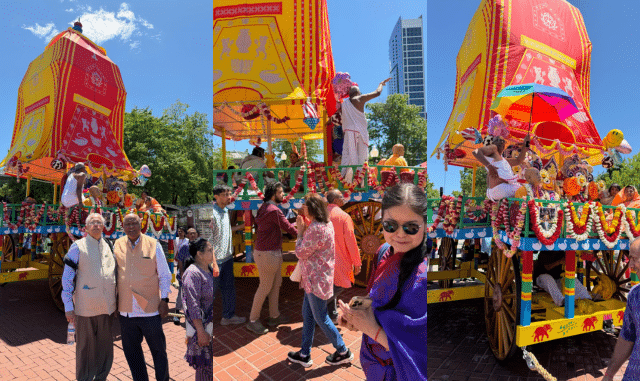
While thousands of devotees worldwide prepare for the grand Jagannath Ratha Yatra in Puri this July, a chariot bearing Lord Jagannath, Balabhadra, and Subhadra paraded through Baltimore’s Inner Harbor on May 30 — weeks before the astronomically and scripturally correct date.
The event, organised by ISKCON Baltimore at McKeldin Square, has triggered sharp backlash from the local Hindu community and global Jagannath devotees who view it as a direct violation of centuries-old Vedic traditions.
Just five days earlier, on May 25, Naresh C. Das, Chairman of the Jagannath Organization for Global Awareness (JOGA), Maryland, sent a strongly worded “Memorandum of Protest” to ISKCON Baltimore’s president. The letter, addressed also to Gajapati Maharaja Dibyasingha Deb of Puri and senior Indian government officials, accused the temple of proceeding with the festival on a non-prescribed tithi.
“The ‘Chaturdha Murtis’ must NOT be removed from the holy shrine at no other time other than those lunar days — one day period for Snana Yatra and nine-day period for Ratha Yatra, as suggested by Shree Mandir, Puri,” the letter states.
Citing authoritative scriptures including the Skanda Purana, Brahma Purana, Padma Purana, and Niladri Mahodaya, Das reminded ISKCON that this year’s authentic Ratha Yatra falls between July 16–24, 2026, beginning on Ashadha Shukla Paksha Dvitiya.
The protest letter also highlighted a written commitment made by the ISKCON GBC Chairman in October 2025 — in response to a directive from the Shree Mandir authorities — that all ISKCON temples worldwide would henceforth observe Snana Yatra and Ratha Yatra strictly according to the Puri lunar calendar. That assurance, the letter notes, appears to have been ignored in Baltimore.
Despite the appeal delivered in a spirit of “humility, respect, and constructive engagement,” the procession went ahead as planned, complete with a beautifully decorated chariot and a “Festival of India” cultural program.
Video messages from angry local devotees, widely circulated on social media, captured the depth of hurt feelings. Many described the early celebration as “Adinia Ratha Yatra” (untimely chariot festival) and accused ISKCON of prioritising convenience over scriptural sanctity.
Historical and Spiritual Context
For over five centuries, the sacred Ratha Yatra in Puri has been observed on exact tithis fixed by the lunar calendar. Srila Prabhupada, founder of ISKCON, initially emphasised strict adherence to these dates in his global mission. While some temples later adopted “desha-kaala-paatra” flexibility for overseas observances, the recent GBC commitment was seen by many as a return to traditional integrity.
The Jagannath Organization for Global Awareness argues that repeated deviations outside India are “inconsistent with sacred injunctions” and deeply wound the sentiments of millions of devotees who revere these festivals as divine commandments.
As the chariot rolled through Baltimore’s waterfront on Saturday, the contrasting emotions were clear: joy among participating devotees on one side, and a profound sense of betrayal among those who believe the sanctity of Lord Jagannath’s festival was compromised.
Whether this controversy will prompt ISKCON’s global leadership to revisit its calendar policy remains to be seen. For now, the message from Maryland’s Jagannath devotees is loud and clear: tradition is not negotiable. Jai Jagannath.