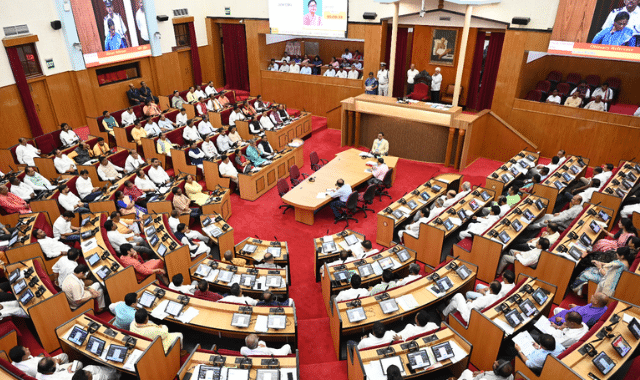
The seventh session of the 17th Odisha Legislative Assembly came to an abrupt close on Monday, four working days ahead of schedule, after Congress legislators rang bells at the Speaker’s podium and the Biju Janata Dal walked out over the Mines and Minerals (Development and Regulation) Amendment Act. Speaker Surama Padhy adjourned the House sine die at 6:54 pm.
The session had been summoned from September 22 to October 3, with nine working days on the calendar. It lasted five sittings. The last afternoon was short, loud, and decisive.
Chaos from the first minute
The House met at 4 pm under the Speaker’s chair. Almost immediately, Congress MLAs Tara Prasad Bahinipati, Mangu Khilla, Kadraka Appala Swamy and Pabitra Sahu rang bells, climbed towards the podium and created a ruckus, demanding a discussion on the MMDR amendment. BJD members joined the protest and walked out at 4:06 pm.
Business did not stop. Even with the opposition in revolt, the treasury benches placed reports and pushed legislation. Seven reports were presented, and four official bills were passed during the sitting. The afternoon sitting ran only till 4:21 pm. Padhy then adjourned the House for ten minutes.
When proceedings resumed at 4:31 pm, Congress members again raised slogans and pressed the Chair for a debate on the mining law. The demand was not taken up. At 4:38 pm they too left the House.
House runs without the opposition
From that point the Assembly functioned without opposition members until 6:54 pm. On the Deputy Speaker’s direction, Government Chief Whip Saroj Kumar Pradhan, Parliamentary Affairs Minister Dr. Mukesh Mahaling, Minister Rabi Narayan Naik, and MLAs Santosh Khatua and Bhaskar Madhei were asked to request Leader of the Opposition Naveen Patnaik and other opposition members to return. Repeated appeals failed. They declined to re-enter.
Chief Minister Mohan Charan Majhi and Speaker Padhy then placed on record the customary thanks. After the state anthem, the Chair adjourned the House for an indefinite period.
The morning had already been washed out. Opposition members had stalled Question Hour over the same MMDR amendment, forcing adjournments till 4 pm — the fifth consecutive sitting day marked by protest since the session opened on September 22.
What the session actually delivered
Official figures prepared for the valedictory address show a thin legislative harvest for a monsoon sitting:
- Sittings held- 5
- Days for official business- 4
- Day for private members’ business- 1
- Obituary references- 6
- Starred question notices received- 950
- Starred questions answered- 8
- Unstarred question notices received- 1,396
- Answers to unstarred questions laid- 1,937
- Adjournment motion notices- 1
- Papers laid / re-laid- 6
- Annual reports laid- 18
- Committee reports presented- 3
- Ordinances laid- 7
- Official bills introduced- 4
- Official bills passed- 6
- CAG report presented- 1
Nine hundred and fifty starred questions were tabled; eight were answered on the floor. The numbers tell the story as clearly as the walkout: most of the session was spent in confrontation, not interrogation.
Why the House broke
The flashpoint was the MMDR Amendment Act, 2026, already passed by Parliament. BJD and Congress call it an attack on Odisha’s control over its mineral wealth and on the rights of mining-affected communities. They wanted a discussion and a state-level stand against the law. The government did not concede that debate on the terms the opposition demanded. BJD also took the fight outside the House, with Naveen Patnaik leading a protest in the capital the same day.
The government, for its part, used the emptied benches to clear pending official business and close the session rather than drift through four more sitting days already shadowed by disruption.
The monsoon session of 2026 will be remembered less for the six bills it passed than for the bells at the podium, the empty opposition seats, and a House that chose to fall silent four days early.