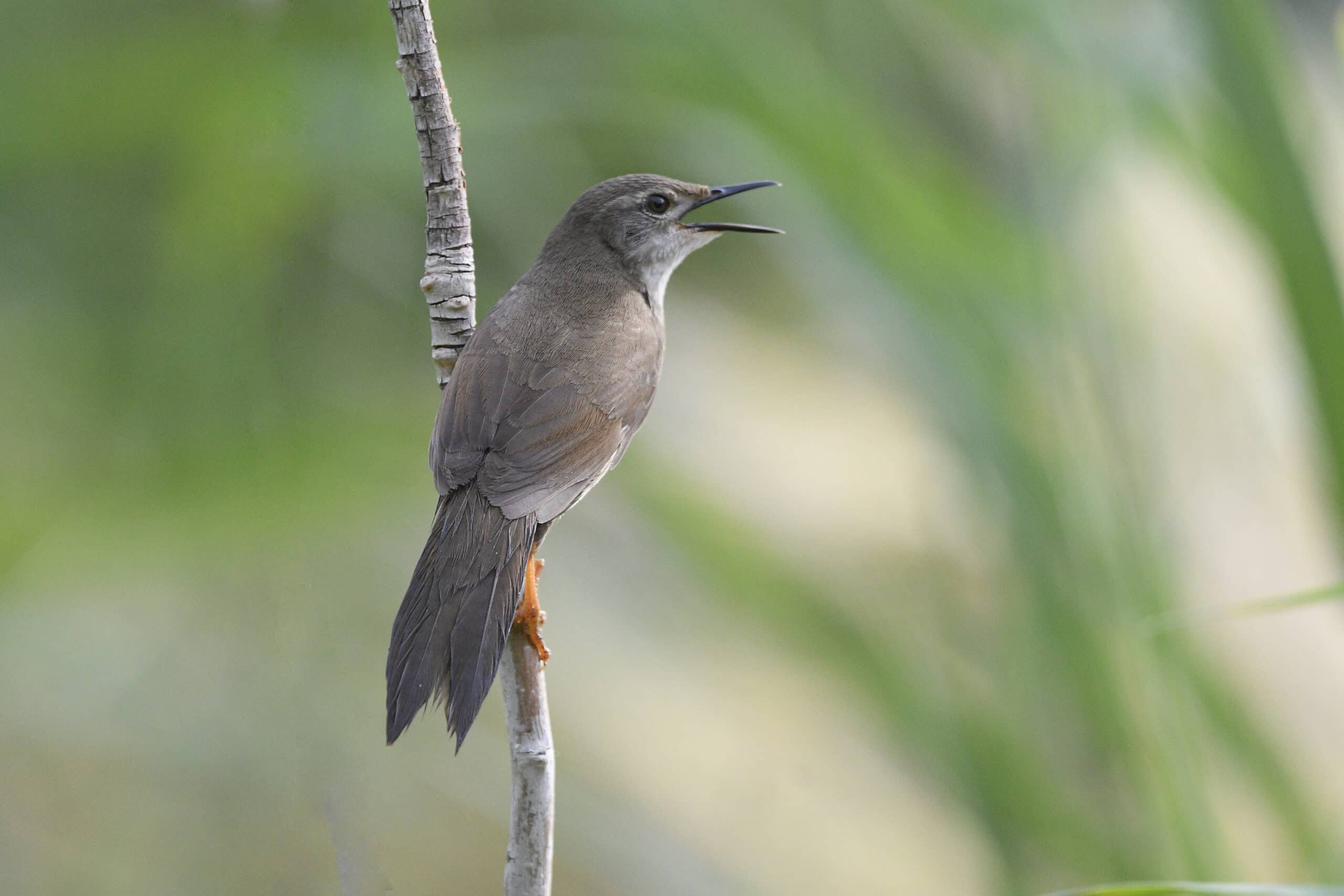
The Long-billed Bush Warbler, also known as the Long-billed Grasshopper Warbler, is one of the most elusive and least-photographed birds of Asia. Secretive by nature, it spends most of its life hidden among dense alpine grasses, shrubs, and willow thickets, rarely revealing itself even to experienced birdwatchers.
Its warm olive-brown upperparts blend perfectly with the mountain vegetation, while the pale buff underparts are delicately streaked across the breast. The bird’s most distinctive feature is its long, slender bill-an adaptation that allows it to probe deep into grasses and foliage in search of insects, spiders, caterpillars, beetles, and other small invertebrates.
Found only in isolated regions of China, India, Pakistan, and Tajikistan, this remarkable warbler inhabits high-altitude meadows and shrubby Himalayan slopes, where harsh weather and inaccessible terrain make it exceptionally difficult to observe. Unlike brightly coloured birds that seek attention, the Long-billed Bush Warbler survives through silence, camouflage, and patience.
Every confirmed sighting carries immense scientific value, helping researchers better understand its distribution, habitat preferences, and conservation needs. Documenting this mysterious species is not merely a photographic achievement-it is a significant contribution to biodiversity documentation, conservation science, and open knowledge. Every freely accessible image shared through Wikimedia Commons ensures that one of the Himalayas’ rarest voices will continue inspiring researchers, students, conservationists, and nature lovers across the world.
A Feat During the Wiki Commons of the Wild Mission
A Rare Himalayan Secret Captured for the World
Wildlife Storyteller K. Shiva Kumar Documents One of India’s Rarest Birds During Wikimedia-Supported Expedition
Wildlife conservationist, wildlife storyteller, and Wikimedian K. Shiva Kumar has successfully documented one of India’s rarest and most elusive birds-the Long-billed Bush Warbler (Locustella major), also known as the Long-billed Grasshopper Warbler-during the Wiki Commons of the Wild – India Expedition, supported by the Wikimedia Foundation.
The achievement marks another important milestone in Kumar’s continuing mission to document India’s extraordinary biodiversity and make it freely accessible to researchers, educators, conservationists, students, and nature enthusiasts through Wikimedia Commons.
The expedition began in Jammu & Kashmir, the first phase of an ambitious journey across India to document endemic, endangered, and lesser-known wildlife species. While reviewing Wikimedia Commons before the expedition, Kumar noticed that photographs of the Long-billed Bush Warbler were extremely scarce and largely represented from outside India. That observation inspired him to search for the species within the Indian Himalayas.
The Long-billed Bush Warbler is one of Asia’s most secretive birds, occurring only in limited regions of China, India, Pakistan, and Tajikistan. Because it remains hidden within dense alpine grasses and shrubs, it is seldom photographed, even by experienced ornithologists.
Determined to document the species, Kumar immediately travelled to Kargil, Ladakh, accompanied by wildlife senior biologist Riyan Sofi from Jammu & Kashmir. The expedition demanded days of intensive searching across challenging Himalayan terrain, where changing weather, high elevations, and dense vegetation made locating the bird extremely difficult.
After nearly a week of patient fieldwork, persistence finally paid off.

The elusive Long-billed Bush Warbler briefly emerged from its concealed habitat, providing a rare opportunity to document one of the least-photographed birds found in the Indian Himalayas.
“It was an unforgettable moment,” Kumar said.
“Whenever I find time, I search for species that have little or no photographic representation on Wikimedia Commons. I first saw photographs of this bird from Gilgit on Wikipedia and realised how rarely it had been documented. Photographing the Long-billed Bush Warbler in India is not just a personal achievement-it is a contribution to conservation and open knowledge.”
According to Kumar, documenting such species goes beyond wildlife photography.
“Every freely licensed photograph uploaded to Wikimedia Commons becomes a permanent educational resource. Students, wildlife researchers, scientists, conservationists, naturalists, educators, and bird enthusiasts across the world can access these images without barriers. That is the true strength of Wikimedia.”
The Wiki Commons of the Wild initiative focuses on documenting India’s remarkable biodiversity while encouraging people to contribute freely licensed wildlife photographs to Wikimedia Commons. Throughout the expedition, Kumar has interacted with wildlife photographers, field biologists, researchers, students, forest officials, and conservation organisations, inviting them to become part of the global open-knowledge movement.
Over the course of the mission, Kumar has steadily built a strong network of field biologists, senior scientists, conservationists, and naturalists across India. Their local knowledge has greatly strengthened biodiversity documentation efforts and expanded opportunities to record species that remain poorly represented in open-access resources.
The Long-billed Bush Warbler is only one among several remarkable species documented during the expedition. Kumar’s ongoing fieldwork has also contributed valuable records of several rare birds and lesser-known wildlife, further enriching Wikimedia Commons with scientifically valuable, freely accessible biodiversity resources.
Kumar credits much of the success of the expedition to the encouragement and guidance of Mr. Praveen Das, Lead Partnerships Manager – South Asia, Wikimedia Foundation.
Kumar believes that every successful conservation mission is built on teamwork. While he leads the field expeditions, he credits the Wikimedia community for strengthening his work. He is especially grateful to experienced Wikimedians Satdeep Gill and Gopala Krishna A, whose technical expertise, guidance, and support on the Wikimedia platform have helped transform field documentation into valuable open knowledge. “Together, we are preserving India’s biodiversity for the world,” Kumar says.
“His encouragement gave me the confidence to think beyond ordinary documentation. The Wikimedia Foundation has shown that open knowledge can directly support conservation. Without this support, many of these biodiversity records would never have reached a global audience.”
Beyond photography, the project continues to inspire new contributors.
By introducing wildlife photographers, students, researchers, and conservationists to Wikimedia Commons, the initiative is helping build a community that believes biodiversity knowledge should remain freely available for everyone.
Each uploaded photograph not only preserves an image but also creates an enduring scientific record that may assist future ecological studies, species identification, conservation planning, environmental education, and public awareness.
As biodiversity faces increasing pressure from habitat loss and climate change, initiatives such as Wiki Commons of the Wild – (Discover. Document. Celebrate India’s Natural Heritage) demonstrate that documenting nature is itself a powerful act of conservation.
Recognized for his contributions to wildlife conservation by renowned organizations such as the Small Wild Cat Conservation Foundation and the Wildlife Trust of India, K. Shiva Kumar continues to dedicate his passion to the mission of Wikimedia Commons. Through the Wiki Commons of the Wild initiative, he is inspiring young photographers, researchers, students, and nature enthusiasts across India to contribute freely accessible biodiversity documentation. Kumar believes that India’s forests still hold countless lesser-known and undocumented species waiting to be discovered. By understanding habitats, studying migration patterns, conducting ethical field research, and sharing knowledge openly, he hopes to reveal India’s hidden natural treasures while strengthening conservation, education, and scientific research for future generations.
For Kumar, every expedition is driven by a simple belief:
“A single photograph can preserve a species’ story forever. When that photograph is shared freely with the world, its value becomes limitless.”

Contributed by K. Shiva Kumar: Master’s in Journalism and Mass Communication | Conservation Storyteller | Wildlife Photographer