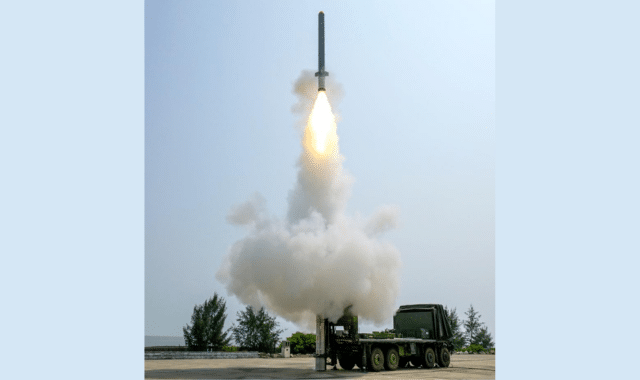
In a significant boost to India’s indigenous defence capabilities, the Defence Research and Development Organisation (DRDO) successfully conducted the flight-test of the Long Range Land Attack Cruise Missile (LRLACM) from Dr APJ Abdul Kalam Island off the coast of Odisha today.
The missile roared into the skies and met every test objective with precision, as confirmed by real-time data from the sophisticated tracking instruments of the Integrated Test Range, Chandipur. This maiden or developmental flight marks a crucial step forward in India’s quest for a potent, long-range strike capability that can be launched from land against high-value targets deep inside enemy territory.
Fully developed within India, the LRLACM showcases the strength of the nation’s defence ecosystem. Every subsystem — from propulsion and guidance to avionics and warhead integration — was designed and manufactured by DRDO laboratories in collaboration with Indian industry partners. The Aeronautical Development Establishment (ADE) in Bengaluru served as the nodal laboratory for this ambitious project.
Senior DRDO officials, along with representatives from the Indian Navy and Indian Air Force, witnessed the test, underlining the tri-service relevance of the weapon system. The missile is expected to significantly enhance the strike range and operational flexibility of India’s armed forces.
Raksha Mantri Rajnath Singh congratulated the DRDO team and industry partners on this stellar achievement. “This successful test is a testament to the dedication and expertise of our scientists and engineers,” he said. Defence Secretary and Chairman, DRDO, Rajesh Kumar Singh personally monitored the launch activities and extended his congratulations to all team members involved.
This achievement aligns perfectly with the government’s vision of Atmanirbhar Bharat (Self-Reliant India) in defence. With its extended range, high accuracy, and terrain-hugging capability, the LRLACM is poised to become a game-changer in modern warfare, providing India with a credible standoff weapon that can be deployed across multiple platforms in the future.
As India continues to modernise its armed forces, today’s successful test sends a clear message: Indian defence technology is not just catching up — it is ready to lead.