Iran has officially begun the funeral of late Supreme Leader Ayatollah Ali Khamenei, with millions of mourners expected to take part in a six-day farewell ceremony that has drawn worldwide attention.
The state funeral began on July 4 at Tehran’s Grand Mosalla, months after Khamenei was killed during the conflict involving Iran, Israel and the United States.
Thousands gathered from early morning to pay their last respects, while authorities expect between 15 and 20 million people to participate over the coming days.
Millions Expected as Funeral Begins
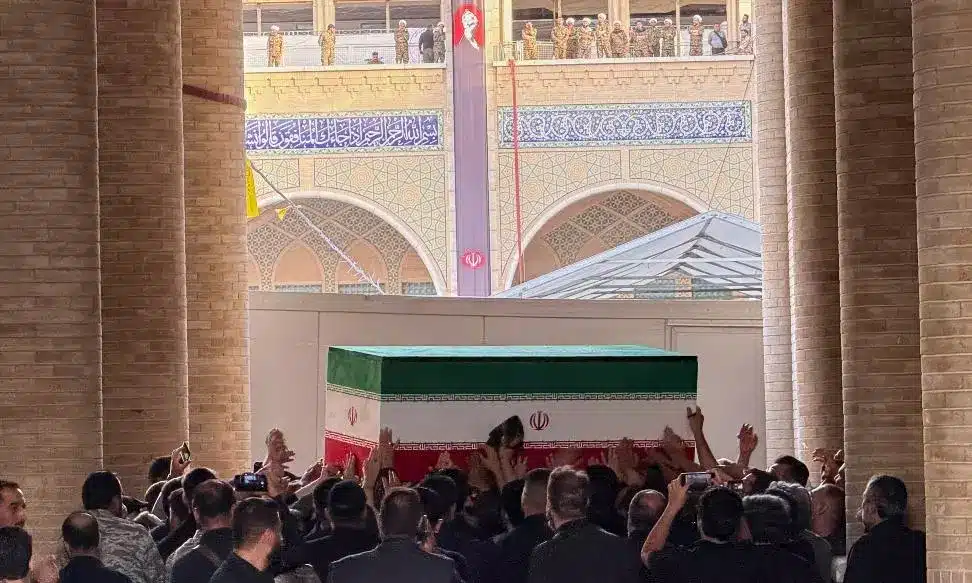
The funeral ceremony opened at Tehran’s Grand Mosalla, where Khamenei’s flag-draped coffin was placed inside a glass enclosure. Emotional mourners offered prayers, recited verses and paid tribute to the late leader.
Iranian officials believe the turnout could make it one of the country’s largest public gatherings since the funeral of Ayatollah Ruhollah Khomeini in 1989.
Six-Day Funeral Schedule
The funeral will continue across several cities in Iran and Iraq over the next six days.
Khamenei’s body will remain in Tehran until July 6 before a large public procession moves through the capital. On July 7, the coffin will be taken to the holy city of Qom. The following day, commemorative ceremonies will take place in the Iraqi cities of Najaf and Karbala.
The final burial is scheduled for July 9 at the Imam Reza shrine in Mashhad, Khamenei’s hometown.
Family Members Also Honoured
The ceremony also honoured several members of Khamenei’s family who were killed during the conflict.
Their coffins were displayed alongside his, including those of his eldest daughter, son-in-law, a 14-month-old granddaughter and the wife of Iran’s new Supreme Leader, Ayatollah Mojtaba Khamenei.
Why July 4 Has Drawn Global Attention
The funeral began on July 4, which marks the 250th anniversary of the founding of the United States.
Although Iranian authorities did not officially explain the timing, sections of the crowd chanted anti-American slogans during the opening ceremony. The date has therefore attracted significant international attention.
Spotlight on Iran’s New Supreme Leader
The funeral is also being closely watched because it is one of the first major public events under Ayatollah Mojtaba Khamenei, who succeeded his father as Iran’s Supreme Leader.
Political observers are monitoring his public appearances and speeches for indications of Iran’s future leadership and foreign policy direction.
World Leaders and Indian Delegation Attend
Senior Iranian leaders, including President Masoud Pezeshkian, Parliament Speaker Mohammad Bagher Ghalibaf and Foreign Minister Abbas Araghchi, attended the ceremony.
Foreign dignitaries also paid their respects, including Pakistan Prime Minister Shehbaz Sharif and former Russian President Dmitry Medvedev.
India was represented by Minister of State for External Affairs Pabitra Margherita and Bihar Governor Lt Gen (Retd.) Syed Ata Hasnain. Congress leader Salman Khurshid, PDP chief Mehbooba Mufti and representatives from different faith communities also attended the funeral.
Tight Security Across Tehran
Authorities have implemented extensive security arrangements across Tehran.
Roads have been closed, traffic restrictions imposed and emergency services deployed across the city. Medical teams and water distribution facilities have also been stationed at key locations as temperatures remain above 35 degrees Celsius.
Strong Political Messages During Ceremony
Senior Iranian leaders used the funeral to deliver strong political messages.
Parliament Speaker Mohammad Bagher Ghalibaf said Iran would continue seeking justice for those killed during the conflict. Army Chief Amir Hatami also warned that the country remained prepared to respond if hostilities resumed.
A Funeral with Global Significance
The funeral of Ayatollah Ali Khamenei is more than a national farewell. It has become a significant geopolitical event, attracting global attention amid ongoing tensions in the Middle East.
As millions continue to gather in Tehran and other cities, the ceremonies are expected to shape both Iran’s domestic politics and its international engagement in the coming weeks.