

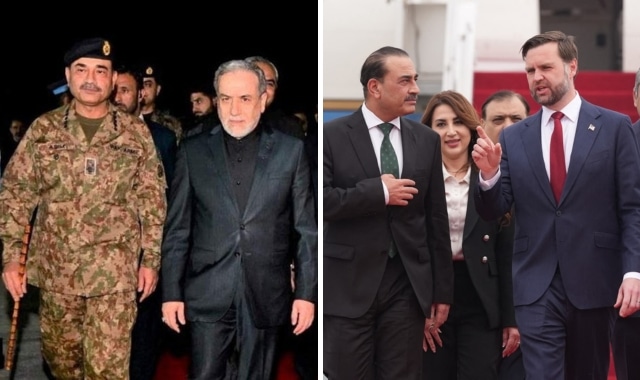
Pakistan army chief Asim Munir delivered a carefully choreographed message through his attire while receiving delegations from Iran and the United States in Islamabad.
His contrasting wardrobe choices highlighted his role as Pakistan’s power centre and underscored the symbolism of “uniform diplomacy.”
Munir welcomed Iran’s 71-member delegation, led by Parliament Speaker Mohammad Ghalibaf and Foreign Minister Abbas Araghchi, in camouflage combat gear. The attire projected him as a soldier standing firm with Tehran, signalling toughness and military solidarity. Hours later, when US Vice President JD Vance arrived at Nur Khan air base, Munir appeared in a formal suit, presenting himself as a statesman ready for diplomatic engagement.
Observers noted that Prime Minister Shehbaz Sharif did not receive either delegation, reinforcing perceptions of Munir as Pakistan’s de facto ruler. Analysts argued that the wardrobe switch was deliberate messaging aimed at both sides. Retired Major General Sanjay Meston remarked that Munir wanted to show he was a soldier with Iran and a diplomat with the Americans, tailoring his image to each audience.
The optics carried weight because both Iran and the US arrived in Islamabad for make-or-break peace talks after securing a fragile two-week ceasefire. Munir’s attire choices were widely interpreted as a calculated move to project authority, toughness, and flexibility in a tense geopolitical environment.
His dual presentation—combat gear for Iran, suit for the US—illustrated how leaders use visual cues to shape perceptions and signal intent. The episode highlighted the growing influence of symbolic gestures in diplomacy and reinforced Munir’s position as the central figure in Pakistan’s political and security landscape.