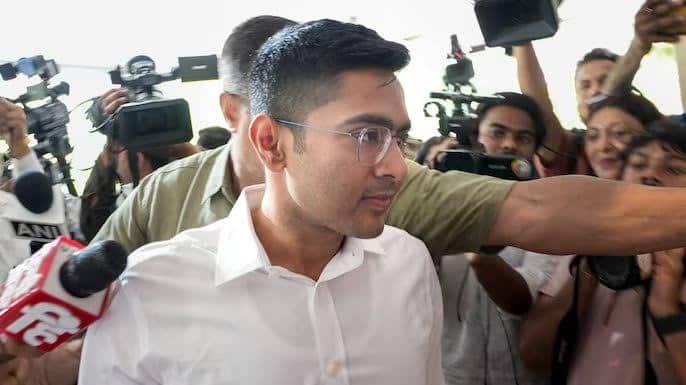
In a significant political development, Trinamool Congress (TMC) national general secretary Abhishek Banerjee met Leader of Opposition Rahul Gandhi in New Delhi, fueling speculation about closer cooperation between the TMC and Congress at a time when Mamata Banerjee’s party is facing one of its toughest political challenges.
The meeting came just a day after TMC supremo Mamata Banerjee held a nearly 50-minute discussion with Congress Parliamentary Party chairperson Sonia Gandhi, signaling a renewed effort to strengthen opposition unity.
What Happened During the Meeting?
According to party sources, Abhishek Banerjee and Rahul Gandhi discussed a range of political issues, including:
- The future strategy of the INDIA alliance.
- Coordination among opposition parties.
- Electoral challenges facing regional parties.
- Rahul Gandhi’s recent remarks on alleged “vote theft.”
- Strengthening cooperation between Congress and TMC.
A senior TMC leader described the interaction as having a “solid bonding” and revealed that discussions extended well beyond the scheduled duration.
Notably, the meeting reportedly lasted around 88 minutes, nearly double the planned time.
Why the Meeting Matters
The timing of the meeting has attracted widespread attention because it comes amid a series of setbacks for the Trinamool Congress.
The party recently suffered a major defeat in the West Bengal Assembly elections and has since witnessed internal turmoil, including:
- A large-scale rebellion among party legislators.
- Resignations from senior leaders.
- Growing concerns about possible splinter groups.
- Challenges to the party’s long-standing dominance in West Bengal.
Political observers believe the TMC leadership is exploring new strategies to stabilize its position and strengthen opposition unity at the national level.
Sonia Gandhi-Mamata Banerjee Meeting Set the Stage
The Abhishek-Rahul meeting followed Mamata Banerjee’s meeting with Sonia Gandhi in Delhi, their first such interaction in nearly five years.
The two leaders reportedly discussed the future of opposition politics and the role of the INDIA alliance in countering the BJP nationally.
Sources indicate that both parties agreed to continue discussions through additional meetings involving senior leadership.
Is a Congress-TMC Alliance on the Cards?
While both parties have dismissed speculation about a merger, neither side has ruled out future electoral cooperation.
For more than a decade, TMC and Congress have largely contested separately in West Bengal. However, the current political situation appears to have opened the door for fresh conversations.
Political analysts suggest that a strategic understanding between the two parties could help consolidate anti-BJP votes in key regions.
A senior Congress leader noted that changing political realities may be prompting both sides to reassess their relationship.
Opposition Unity in Focus
The meetings also underline the broader importance of opposition unity ahead of future political battles.
The INDIA alliance has faced challenges in maintaining cohesion due to regional rivalries and differing political priorities. Recent discussions between TMC and Congress leaders indicate efforts to improve coordination and present a stronger collective front.
At the same time, leaders from both parties stress that discussions remain focused on cooperation rather than organizational integration.
What Happens Next?
According to sources, the TMC leadership is expected to continue engagement with senior Congress leaders, including Congress president Mallikarjun Kharge.
Political observers will closely watch whether these discussions translate into:
- Stronger coordination within the INDIA alliance.
- Electoral understandings in key states.
- Joint campaigns on national issues.
- A new political equation in West Bengal.
For now, the high-profile meetings have sent a clear signal that opposition politics is entering a new phase, with both TMC and Congress exploring ways to navigate an increasingly complex political landscape.
Whether these talks lead to a formal alliance or remain limited to strategic cooperation could shape the future of opposition politics in India.