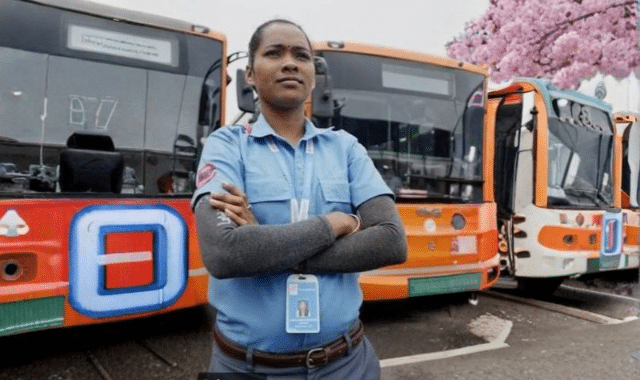
Every morning, as an electric bus quietly rolls out of the Ama Bus depot in Kendujhar, it carries far more than a routine commute. Behind the wheel sits Shubhalakshmi Mahananda—the first woman in Odisha recognized to drive an electric passenger bus—navigating a route long dominated by men and steering a powerful shift toward social change.
Her presence in the driver’s seat delivers a quiet yet decisive blow to long-standing stereotypes. Operating a heavy-duty passenger vehicle requires technical skill, sharp alertness, and strict discipline to ensure commuter safety. Driving an electric vehicle (EV) adds another layer of complexity, demanding a firm grasp of specialized high-voltage operating systems, battery monitoring, and regenerative braking dynamics. Through rigorous training and daily practical experience under Capital Region Urban Transport (CRUT), Shubhalakshmi has embraced these demands with complete confidence.
Her achievement, however, extends well beyond personal victory. When women break into non-traditional fields, they redefine the boundaries of what is possible for future generations. Her journey highlights a vital dimension of sustainable development: access to economic opportunity must never be dictated by gender.
Kendujhar’s expanding EV ecosystem provides the ideal backdrop for this transition. Now equipped with 25 electric buses and a dedicated Ama Bus depot, the district demonstrates that clean public transport is no longer confined to major metropolitan centers. While electric buses significantly reduce tailpipe emissions and urban air pollution, Shubhalakshmi’s story shows that green technology gains its deepest value when paired with human opportunity.
This story takes center stage as Odisha prepares to host the 19th Urban Mobility India (UMI) Conference & Expo 2026 on 23–24 October in Bhubaneswar—marking the first time Eastern India hosts the flagship event. Centered around the theme “Urban Accessibility & Liveability in the Digital Age,” the conference highlights how transport networks can better serve everyday needs while promoting equal access.
While policy debates around mobility often emphasize technology, digital integrations, and grid infrastructure, Shubhalakshmi offers a grounded reminder: true progress is measured by who gets to lead that change. Public transit is more than an asset that moves people—it is an engine for livelihoods, social equity, and inclusion.
For any young woman questioning whether she belongs in a non-traditional career, seeing a woman confidently handling a multi-ton electric bus offers proof that the ceiling has been cracked. From Kendujhar to the rest of the state, Shubhalakshmi Mahananda’s journey delivers a simple, lasting truth—meaningful progress begins when old barriers are challenged on the road every single day.