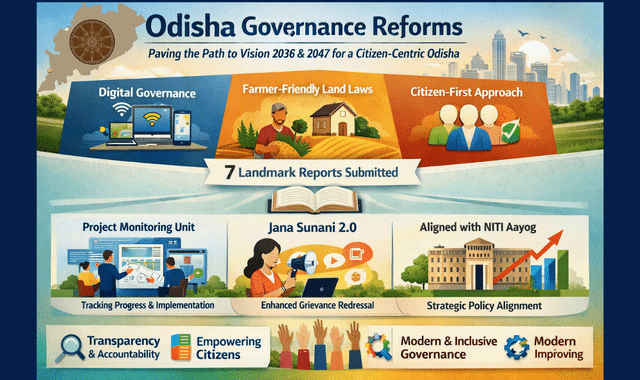
In a significant step towards building a modern, efficient and truly citizen-centric administration, the high-level Administrative and Governance Reforms Committee has submitted seven comprehensive reports to the Odisha government.
Formed through a General Administration Department notification dated October 27, 2025, the panel—chaired by former Chief Secretary Jugal Kishore Mohapatra—aims to align the state’s systems with the ambitious goals of “Developed Odisha: Vision 2036 and 2047.”
The committee has strongly recommended that all seven reports be placed in the public domain and that the state government set clear timelines for examining and implementing the accepted recommendations, followed by regular reviews.
Two of the most closely watched proposals appear in the first volume. To tackle chronic delays in large infrastructure projects, the panel has called for a dedicated Digital Monitoring Unit. Projects costing more than ₹50 crore would come under a common Project Management Unit headed by an Additional Chief Secretary, acting as a shared facility for all departments. Smaller works could continue using the existing WAMIS system. The recommendations also emphasise milestone-based reviews and a unified dashboard covering land acquisition, clearances, right-of-way and utility shifting.
Equally transformative is the call for a new land-lease law within one year, modelled on NITI Aayog’s framework. The proposed legislation would protect the ownership rights of genuine farmers while enabling leaseholders—including women farmers, Self-Help Groups, Joint Liability Groups and Farmer Producer Organisations—to access credit, insurance and other benefits, thereby boosting agricultural productivity.
Other key reports outline bold reforms across critical sectors:
- Restructuring the public grievance system into “Jana Sunani 2.0,” developed with technical support from the University of Chicago’s Data, Policy and Innovation Center (DPIC), with a sharper focus on citizen satisfaction.
- Establishing an independent institution for outcome monitoring and evaluation.
- Creating integrated digital land records and enhancing survey capacity.
- Introducing a Population Health and Wellness Score, a statewide teleconsultation grid and a command centre in the health sector.
- Making career-inclusive training mandatory at every level and strengthening the Gopabandhu Academy of Administration.
The committee finalised its priority areas after extensive consultations with the Chief Secretary and senior officials. The overarching goal remains clear: sharper administrative efficiency, greater transparency and accountability, inclusive governance, and everyday ease for ordinary citizens.
If implemented with urgency and political will, these recommendations could mark one of the most far-reaching governance overhauls Odisha has seen in recent decades—turning the vision of a developed state into measurable, citizen-visible reality.