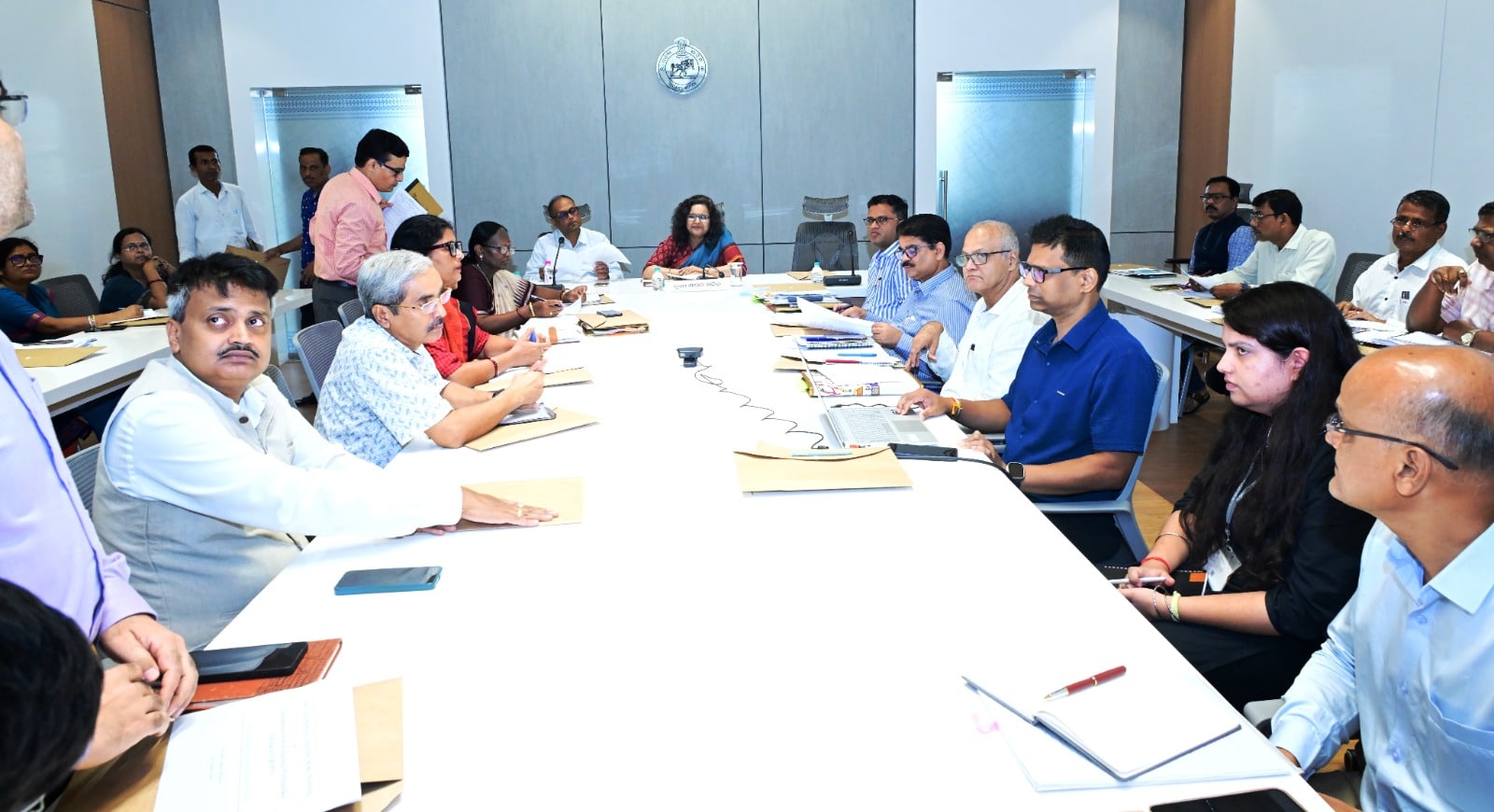
In a significant step toward transforming primary education across the state, the first meeting of the State Level Management Committee for the Godabarish Mishra Adarsha Primary Vidyalaya scheme was held on Monday at Lok Seva Bhawan in Bhubaneswar.
Chaired by Chief Secretary Anu Garg, the high-level gathering focused on reviewing infrastructure progress, strengthening implementation mechanisms, and refining guidelines to ensure every child in Odisha gains access to quality, inclusive primary education.
Development Commissioner and Additional Chief Secretary Deoranjan Kumar Singh, Commissioner-cum-Secretary of the School and Mass Education Department N. Thirumala Naik, along with other senior departmental officials who serve as committee members, attended the meeting.
The session began with a detailed presentation by the School and Mass Education Department on the committee’s role, responsibilities, overall scheme implementation, and the functioning of the specially constituted State Level Cell for monitoring and oversight. Emphasis was placed on inter-departmental coordination, regular progress reviews, and timely policy interventions to keep the programme on track.
Officials reviewed construction progress of the model schools being built by implementing agencies across various districts. The scheme currently covers a total of 322 schools—118 in the first phase and 204 in the second. Chief Secretary Garg examined the status of works by different construction agencies and issued clear directions to accelerate the pace of construction while maintaining quality standards.
To make the scheme more practical and effective on the ground, the committee discussed proposed amendments to school selection and infrastructure guidelines. In several locations, the shape, size, and dimensions of available land make the previously approved square building plans difficult to implement. Officials therefore proposed allowing rectangular plans. Discussions also covered strengthening the technical, academic, administrative, financial, and human resource capacities of the dedicated Godabarish Mishra Adarsha Primary School Cell.
Further flexibility was recommended on land-related issues. Where government or private land near proposed school sites can be acquired, it should be pursued. The guideline restricting schools only to panchayat headquarters is proposed to be relaxed so that, if land is unavailable there, schools can be established in the most densely populated areas within the panchayat.

The scheme’s operational guidelines received approval from the Hon’ble Chief Minister in September 2025. The State Level Management Committee itself was constituted in March 2026 to provide policy guidance, strategic direction, and continuous monitoring. Its core responsibilities include updating school selection and infrastructure norms based on field feedback, ensuring inter-departmental coordination, selecting implementing agencies, optimising resource allocation, resolving emerging challenges, and guaranteeing that the programme delivers qualitative and inclusive education along with the holistic development of students.
Once completed, these model schools will feature modern, child-friendly environments including classrooms, a children’s garden (shishu batika), entrance lobby, headmaster’s room, staff room, store room, office, and other essential facilities. Building designs will be adapted to local site conditions without compromising quality.
Chief Secretary Garg underlined that the fundamental objective of the Godabarish Mishra Adarsha Primary School scheme is to deliver quality primary education backed by improved infrastructure. She stressed that after construction, ensuring adequate numbers of competent teachers and necessary supporting facilities for students will remain a government priority. She called upon all stakeholders to maintain high aspirations, quality standards, and a long-term vision at every stage of implementation.
The meeting concluded with a strong resolve to implement the scheme in a time-bound and quality-focused manner so that every child in Odisha can benefit from a better learning environment and equitable educational opportunities.