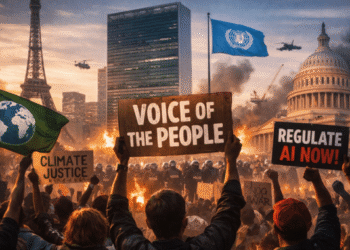

Having served from 1999 to 2003 as the first Indian Secretary-General of the Colombo Plan—a regional intergovernmental organization built entirely on the spirit of collective progress—I feel compelled to share my perspective on the alarming global drift toward unilateralism today.
Conceived at the 1951 Commonwealth Conference on Foreign Affairs in Ceylon (now Sri Lanka), the Colombo Plan was established to drive economic and social development across the Asia-Pacific region. Founded by visionary statesmen—including Jawaharlal Nehru (India), Don Stephen Senanayake and J.R. Jayewardene (Ceylon), Percy Spender (Australia), Ernest Bevin (United Kingdom), Lester B. Pearson (Canada), Ghulam Mohammed (Pakistan), Frederick Doidge (New Zealand), and Paul Sauer (South Africa)—the organization was built on a simple yet transformative premise: genuine cooperation through shared experience.
Today, expanded to 26 member nations, its enduring legacy offers a blueprint for how international governance should work.
A Visionary Model for Human Capital and Regional Growth
During my tenure as Secretary-General, our primary objective was to transform the Colombo Plan into a forward-thinking, highly creative institution. We significantly expanded our operational reach by strengthening strategic partnerships with major global entities, including the World Bank, Asian Development Bank (ADB), USAID, WFP, UNICEF, UNDP, UNESCAP, the UN Office on Drugs and Crime (UNODC), and the US Department of State.
This collaborative momentum marked a vibrant era for the organization:
Expanding Global Footprint: In 2001, as we celebrated our 50th anniversary at the 38th Consultative Committee Meeting, Vietnam was formally inducted as a member. The growing appetite for our brand of multilateralism was further evidenced by several nations outside the region expressing keen interest in joining.
New Strategic Initiatives: We launched pioneering programs, including the Colombo Plan–Africa Initiative, the Private Sector Initiative, and a global coalition for drug abuse prevention.
Strong Global Backing: The United States served as a pivotal partner, allocating substantial funding, particularly toward our drug demand reduction programs. Similarly, Japan maintained a deep, historic bond with us. For Japan, joining the Colombo Plan on October 6, 1954, marked its very first entry into an intergovernmental body—serving as the foundational starting point for its postwar international economic cooperation and official development assistance (ODA).
South-South Cooperation: Emerging hubs like South Korea, Singapore, and India actively shared their growing technological and administrative capabilities with fellow members through targeted human capital-building programs and technical conferences.
What Sets the Colombo Plan Apart?
What makes the Colombo Plan distinct from larger, more bureaucratic international bodies is its deeply democratic structure:
Equal Footing: Every member nation pays an identical membership contribution. Unlike traditional multilateral bodies where large financial donors exercise disproportionate sway, every country in the Colombo Plan operates as an equal partner regardless of its GDP.
Dissolving the Donor-Recipient Divide: Rather than enforcing a rigid hierarchy of “donors” and “recipients,” members contribute based on their unique, specialized expertise—whether in capacity building, public policy, private sector development, or addiction prevention.
Mutual Empowerment in Action: A striking example of this collaborative ethos is India’s own history. In the early 1950s, a developing India received assistance through the Colombo Plan from New Zealand to establish the All India Institute of Medical Sciences (AIIMS) in New Delhi—now India’s premier medical institution.
During our quarterly council meetings, this egalitarian architecture fostered an environment of exceptional warmth and productivity. Because the Colombo Plan operates outside contentious geopolitical and security disputes, member states could engage in open, constructive dialogue. Free from the friction that typically plagues larger international arenas, representatives regularly brought fresh solutions to the table on scaling up social prototypes, driving private investment, and strengthening public institutions.
In those rooms, I experienced multilateralism in its purest, most effective form.
The Philosophical Case for Global Cooperation
This lived experience makes the current global shift toward unilateralism and isolationism all the more concerning. Unilateralism is a dead end; it mistakes short-term dominance for long-term stability.
Multilateralism remains the only viable mechanism for bringing nations with vastly different worldviews together. The fundamental engine of global progress is cooperation, and the confrontations tearing at our modern geopolitical fabric stem almost entirely from a breakdown in dialogue.
Allowing space for individuals, societies, and sovereign nations to express their views is essential to preserving our shared humanity. This ethos mirrors classic philosophical defenses of open discourse:
The opinion which it is attempted to suppress by authority may possibly be true. Those who desire to suppress it, of course, deny its truth; but they are not infallible.
— John Stuart Mill, On Liberty
(Mill reminds us that even if our own view is entirely correct, failing to engage with opposing ideas allows truth to decay into dead dogma.)
I disapprove of what you say, but I will defend to the death your right to say it.
— Evelyn Beatrice Hall (summarizing the spirit of Voltaire)
The same principles must guide modern global governance. To solve complex, cross-border challenges—from economic inequality to public health crises—the international community cannot retreat into national silos. We must continue to cherish, protect, and actively foster the spirit of multilateralism that institutions like the Colombo Plan have so quietly and successfully embodied for decades.
✍️ About the Author
Dr. U. Sarat Chandran is a retired IAS officer, former Additional Chief Secretary to the Govt. of Odisha, former Advisor to the IMF, former Secretary-General of the Colombo Plan (Sri Lanka), and former Private Secretary to Dr Manmohan Singh during his tenure as Deputy Chairman of the Planning Commission.
⚖️ Disclaimer
The views and opinions expressed in this article are solely those of the author and do not necessarily reflect the editorial stance of Pragativadi.com. Pragativadi remains committed to providing a platform for diverse perspectives while upholding its editorial independence and integrity.