When a dozen women workers from Keonjhar died because of an ammonia gas leak inside a seafood processing factory in Tamil Nadu in June, the sad side of migrants’ lives came to the fore yet again. For Odisha, this was certainly disturbing news. But it wasn’t something new. Be it the brutal chopping off of the hands of two labourers in Kalahandi in December 2013 or the more recent death of a 19-year-old woman from Kalahandi at a brick kiln in Telangana in December 2025, the realities of poor people going outside to eke out their livelihoods continue to remain harsh.
Time and again, such tales of tragedy, suffering and exploitation faced by migrant labourers, especially from the KBK (Koraput, Balangir & Kalahandi) region, in different parts of the country have made it to the headlines. According to data presented in the Odisha Legislative Assembly in December 2025, 518 migrant workers from the state died while working outside over the past five years. The real numbers could be even higher, as several cases go unreported.
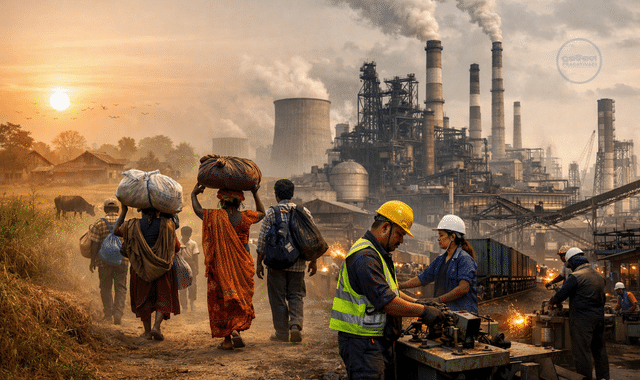
Indeed, the facts on the ground are grim. Going by rough estimates, over two million people from Odisha migrate to other states during the agricultural lean season. The government’s estimate is much lower. But the government’s estimate could miss the real number by a huge margin, given the stealthy ways brokers use. There is no point debating the numbers. It is no secret that the poor from villages in districts such as Balangir, Nuapada, Kalahandi and Rayagada receive wage advances from their recruiters by September every year before they move outside in November. The government’s interventions, including rural job schemes, have not been very effective. Migrants from the state are everywhere: from the brick kilns, stone quarries, and construction sites of Andhra Pradesh, Karnataka, Tamil Nadu and Kerala to cotton mills, diamond polishing units and ship-breaking units in Gujarat. They can also be found at homes and hotels in big cities working as house helps and cleaning boys. In the host states, they form the bottom rung of the economic ladder.
Over the decades, matters have seemingly improved on the ground. But a lot more is required if the state government’s vision for ‘Viksit Odisha’ is to be achieved by 2036. Better opportunities can be made available closer to their homes only with better planning and execution to increase economic activity in the region. Here, the government, the private sector and at times both in partnership have to step in and step up investment to ensure a complete turnaround. What is galling is that there have been half-hearted efforts thus far. Industrialisation is a case in point. For the past several decades, the government has been talking of rapid industrialisation, including downstream and ancillary units through private investment to unlock the potential of the mineral-rich KBK belt. However, in reality, the ecosystem needed to boost much-needed industrialisation is far from being conducive.
Frequent protests, local resistance, inadequate infrastructure, and a lack of skilled manpower have contributed to the slow pace of industrialisation in different parts of the state, particularly the KBK zone, which continues to grapple with poverty, deprivation and exploitation. Several big-ticket investments such as South Korean steel major POSCO’s proposed 12 billion USD steel factory in Jagatsinghpur could not materialise.
Though Odisha’s legendary industrialist Bansidhar Panda set up Indian Metals and Ferro Alloys (IMFA) at Therubali in Rayagada district in 1961, the KBK area has not become a hub of industrial activities in the last six decades. J K Paper Mills at Jaykaypur in Rayagada district (1962); central PSU NALCO’s alumina refinery at Damanjodi in Koraput district (1986), Vedanta’s alumina refinery at Lanjigarh in Kalahandi district (2007) and Aditya Birla Group’s alumina refinery at Kasipur in Rayagada (2013) have undoubtedly created islands of prosperity and spawned thousands of direct and indirect jobs in these districts. These industries have helped check distress migration and generated big revenue for the state. However, the potential remains untapped. It’s well-known that western and southern parts of Odisha are rich in minerals like coal (notably from the Ib Valley coalfields around Jharsuguda), bauxite (in parts of Kalahandi and adjoining belts), iron ore, manganese, limestone, and dolomite, which can support core sectors like aluminium, steel, cement, and power generation. Unfortunately, these areas experience distress migration because of prolonged delays in mining and industrial projects. Instead of benefiting from the resources beneath their land, communities are forced to migrate hundreds of kilometres to take on low-paid, high-risk work.
Migration, vertical or horizontal, is universal when it comes to pursuing economic opportunities. However, it is perturbing when it takes place due to distress, as is the case in KBK and certain other parts of Odisha. What then needs to be done to stop such distress migration? There surely cannot be a singular solution or a one-size-fits-all approach to tackle this complicated and vexed problem. Heavy industries can help provided locals are trained and skilled and made employable. It has to be a combination of factors such as system improvements, welfare measures, industrialisation, job creation, infrastructure and training and hand-holding that can help ease the pressure on natives to travel to distant lands in search of work.
If Odisha is to move out of the cycle of distress migration, then it has to adopt a roadmap that prioritises the operationalisation of mining and industrial projects in high-migration zones, particularly in mineral-rich regions where economic potential remains underutilised. Such a roadmap, if implemented effectively, can transform migration-prone regions into centres of opportunity, ushering in development, curbing distress migration and bringing prosperity to its people.
Rajendra Pattanaik was the head of Corporate Affairs at American power giant AE. He played an important role in OPGC’s 1300-megawatt expansion project.
The views and opinions expressed in this article are solely those of the author and do not necessarily reflect the editorial stance of Pragativadi.com. Pragativadi remains committed to providing a platform for diverse perspectives while upholding its editorial independence and integrity.