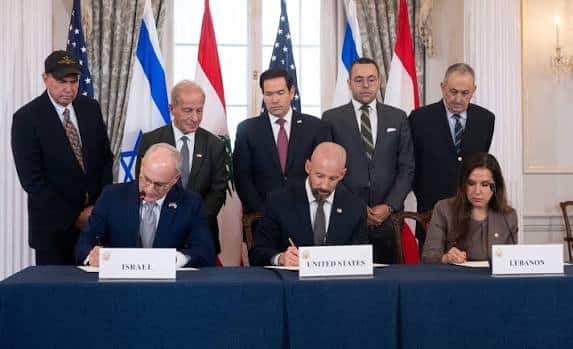
Israel, Lebanon and the United States have signed a trilateral framework agreement aimed at reducing tensions along the Israel-Lebanon border and creating a pathway toward long-term stability.
However, the deal has drawn strong opposition from Hezbollah, which warned that its implementation could spark civil conflict inside Lebanon.
The agreement was signed at the US State Department following several days of negotiations.
US Calls Agreement the First Step Toward Peace
US Secretary of State Marco Rubio described the framework as an important beginning rather than a final settlement.
“Today we’ve taken the first step in what will be a difficult journey, but an important, essential and necessary one,” Rubio said.
He added that implementation would be overseen by a newly established Trilateral Military Coordination Group for Lebanon.
The United States also announced immediate humanitarian assistance worth 100 million US dollars, to be coordinated with the United Nations. In addition, Washington reaffirmed support for strengthening the Lebanese Armed Forces, including more than 30 million US dollars under existing assistance programmes.
Israel Sees New Chapter in Bilateral Relations
Israeli Ambassador to the United States Yechiel Leiter called the agreement a significant diplomatic breakthrough.
According to Leiter, the framework aims to reduce Iran’s influence in Lebanon while creating conditions for peace and security.
He said the agreement represents a future in which both countries respect each other’s sovereignty and coexist peacefully.
Lebanon Welcomes the Agreement
Lebanese President Joseph Aoun described the framework as the first step toward restoring Lebanon’s sovereignty across its territory.
He said the agreement could enable displaced residents to return home and support future reconstruction efforts under the authority of the Lebanese state.
Prime Minister Nawaf Salam also welcomed the development and expressed hope that Israeli troops would begin withdrawing from southern Lebanon, allowing civilians to return safely.
Hezbollah Rejects the Framework
Hezbollah strongly opposed the agreement.
Party lawmaker Hassan Fadlallah argued that Lebanese authorities would be unable to implement the deal without triggering internal conflict.
He also criticised direct engagement between Lebanon and Israel, maintaining Hezbollah’s long-standing opposition to such negotiations.
The group further claimed that the agreement could undermine broader regional understandings involving Iran.
Netanyahu Says Israeli Troops Will Remain for Now
Israeli Prime Minister Benjamin Netanyahu praised the agreement as a major strategic achievement but said Israeli forces would remain in southern Lebanon until Hezbollah is disarmed and no longer poses a security threat.
He said Israel would initially establish two pilot areas where the Lebanese Army could gradually assume responsibility.
Netanyahu also stated that displaced civilians from the Israeli-designated security zone would not immediately be permitted to return under the current arrangement.
Regional Implications
The agreement represents one of the most significant diplomatic efforts between Israel and Lebanon in recent years.
While the United States, Israel and the Lebanese government view the framework as a foundation for greater stability, Hezbollah’s rejection highlights the political and security challenges that remain.
The success of the agreement is expected to depend on its implementation, continued international support and developments on the ground in southern Lebanon.