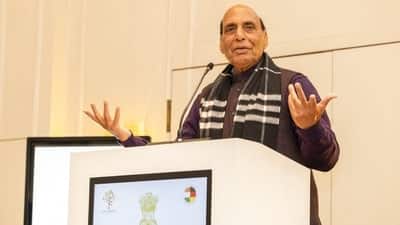
Defence Minister Rajnath Singh has delivered a stern message regarding India’s military posture, revealing that the nation was fully prepared for a “long war” against Pakistan during Operation Sindoor.
Speaking at the ANI National Security Summit 2.0 on Thursday, Singh clarified that India’s decision to halt the operation was a voluntary strategic choice made on its own terms, rather than a result of diminished military capability.
Operation Sindoor: A Strategic Turning Point
Reflecting on the operation launched on May 7, 2025, following the tragic terror attack in Pahalgam, the Defence Minister described it as a “turning point” in India’s geopolitical history. He emphasized that the mission signaled a departure from traditional “diplomatic statements” toward a more assertive, kinetic response.
“During Operation Sindoor, we precisely targeted those who had attacked us. We stopped it voluntarily… and if necessary, we were fully prepared for a long war,” Singh stated.
Countering the ‘Nuclear Bluff’ and Expanding Capabilities
Addressing the threats of escalation during the conflict, Singh noted that India remained undeterred by intimidation.
- Nuclear Threats: Singh revealed that India was threatened with a nuclear attack during the operation but dismissed it as a “bluff.”
- Surge Capacity: The Minister highlighted India’s “military-industrial complex,” asserting that the nation’s ability to ramp up supplies during wartime is more robust now than ever before.
- Zero Tolerance: Under Prime Minister Narendra Modi’s leadership, the government maintains a strict “zero tolerance” policy toward cross-border terrorism.
The ‘Three Dimensions’ of Modern Terrorism
In a pointed critique of the geopolitical landscape, Singh likened terrorism to the “nectar in Ravana’s navel,” suggesting that tactical victories are insufficient if the source remains intact. He argued that terrorism must be fought across three critical fronts:
- Operational: Direct military action against threats.
- Ideological: Uprooting the belief systems that fuel extremism.
- Political: Eliminating the state-sponsored patronage that allows terror cells to thrive.
India’s IT vs. Pakistan’s IT
The Defence Minister drew a sharp contrast between the two nations, noting that while both gained independence simultaneously, their global reputations have diverged significantly. While India is recognized as a global hub for Information Technology, he labeled Pakistan as the “epicentre of International Terrorism.”
Singh concluded by reassuring the nation that the Indian armed forces have expanded their “surge capacity,” ensuring they are prepared for any sudden need or prolonged engagement.