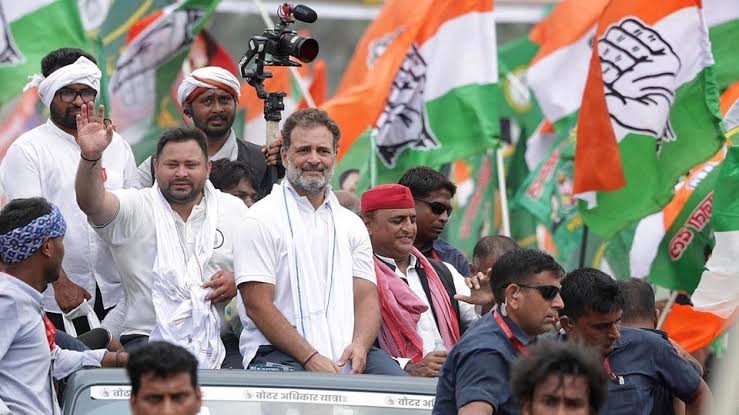
A fresh political confrontation erupted between the Bharatiya Janata Party (BJP) and the Congress on Thursday after Leader of Opposition Rahul Gandhi warned of an impending “economic tsunami” in India. The remarks prompted a sharp response from BJP IT Cell chief Amit Malviya, who accused Gandhi of spreading fear and misrepresenting the country’s economic situation.
Rahul Gandhi, while addressing an event organized by the Adivasi Congress at Indira Bhawan, claimed that India was facing serious economic challenges due to what he described as the weakening of safeguards that previously protected the economy from global shocks.
“The country is heading towards a dangerous economic situation. Rising prices are only the beginning,” Gandhi said, adding that the government’s economic policies had reduced India’s ability to withstand international uncertainties.
The Congress leader also made a political prediction, stating that Prime Minister Narendra Modi may not remain in office a year from now. His comments quickly triggered reactions from BJP leaders.
Amit Malviya Rejects Economic Crisis Claims
Responding through a post on social media platform X, Amit Malviya dismissed Gandhi’s remarks as “fear mongering” and argued that India’s economic fundamentals remain strong.
According to Malviya, several indicators demonstrate the resilience of the Indian economy. He highlighted a 12.9% increase in e-way bill generation during May 2026, strong Purchasing Managers’ Index (PMI) readings for both manufacturing and services sectors, and retail inflation remaining below the Reserve Bank of India’s target level.
Malviya also pointed to record foreign direct investment inflows of $94.5 billion during FY26 and robust foreign exchange reserves supported by strong services exports.
“These are not signs of an economy lacking protection against global shocks. They reflect stability, resilience, and sustained growth,” Malviya said.
Government Measures Highlighted
The BJP leader further outlined several government initiatives aimed at protecting businesses, consumers, and employment.
He cited excise duty reductions on fuel during periods of high global crude oil prices, targeted supply-side interventions to manage inflation, and expanded credit support under the Emergency Credit Line Guarantee Scheme (ECLGS) 5.0.
According to Malviya, the scheme provides full guarantee coverage for eligible MSMEs and significant support for sectors such as aviation, helping businesses manage economic volatility while protecting jobs and supply chains.
He also referred to the Union Cabinet’s approval of ₹37,500 crore for coal and lignite gasification projects, which are expected to generate significant investment and enhance energy security.
BJP Targets UPA-Era Economic Performance
In his response, Malviya compared the current economic situation with the period between 2009 and 2014 under the Congress-led United Progressive Alliance (UPA) government.
He claimed that during those years the rupee weakened significantly, foreign exchange reserves declined, and India’s import cover fell sharply. According to him, these developments reflected greater economic vulnerability compared to the present situation.
“India’s economic shock absorbers were weakened during the UPA years, not under the current government,” Malviya asserted.
Political Debate Intensifies
The exchange highlights the growing political debate over India’s economic direction ahead of future electoral contests. While the Congress continues to raise concerns about inflation, employment, and economic management, the BJP maintains that key indicators demonstrate economic stability and resilience despite global uncertainties.
With both parties presenting contrasting assessments of the economy, economic performance is expected to remain a major political issue in the months ahead.