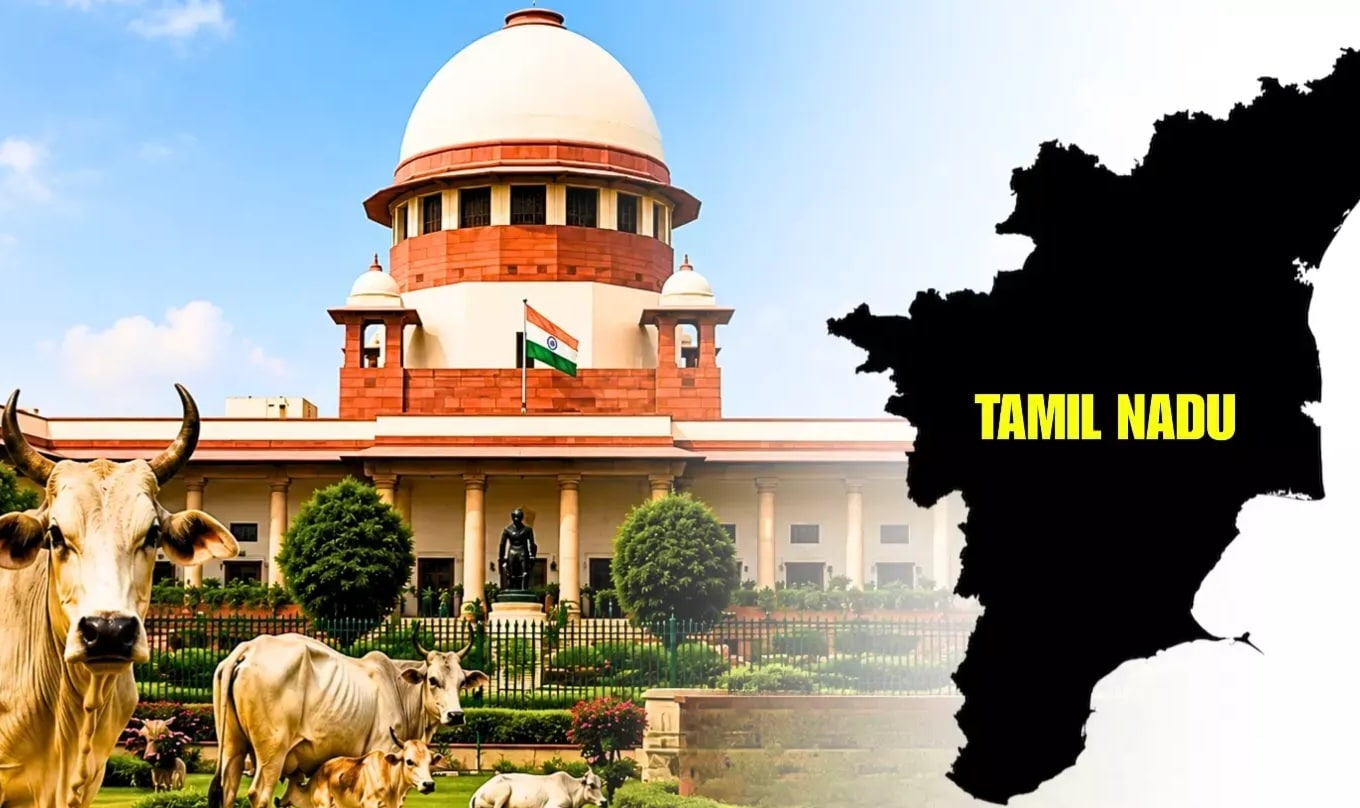
The Supreme Court of India on Monday stayed the Madras High Court order that imposed a statewide ban on the slaughter of cows and calves in Tamil Nadu, granting interim relief to the state government led by Chief Minister Vijay.
A bench comprising Justices Vikram Nath and Sandeep Mehta passed the interim order while issuing notice on a Special Leave Petition (SLP) filed by the Tamil Nadu government.
Supreme Court Observations
According to reports, the apex court observed that the final paragraph of the Madras High Court’s order, which directed a statewide ban on cow and calf slaughter, appeared to require “correction.”
The interim stay will remain in force while the Supreme Court examines the legality of the High Court’s directions.
Tamil Nadu Government’s Arguments
The Tamil Nadu government challenged the High Court’s May 27 order, arguing that it conflicted with the provisions of the Tamil Nadu Animal Preservation Act, 1958.
The state submitted that while the High Court had rightly directed that animal slaughter should take place only at authorised slaughterhouses, it simultaneously imposed a blanket ban on cow and calf slaughter across the state, creating a contradiction.
The government also pointed out that the 1958 Act permits the slaughter of cows above the age of 10 years that are no longer fit for breeding or agricultural work, subject to certification by the competent authority.
Background of the Case
The Madras High Court issued the order while hearing a public interest litigation (PIL) filed by K. Surya Prasanth, general secretary of the Hindu Makkal Katchi.
The petition had sought directions to ensure that animal slaughter took place only at designated slaughterhouses. However, the High Court expanded its directions to prohibit the slaughter of cows and calves across Tamil Nadu on Bakrid and on any other day.
The High Court had relied on a 1976 judgment that emphasised the protection of cows to safeguard milk production and the rural economy.
With the Supreme Court’s interim stay, the legal position under the Tamil Nadu Animal Preservation Act, 1958 continues to operate until further orders.