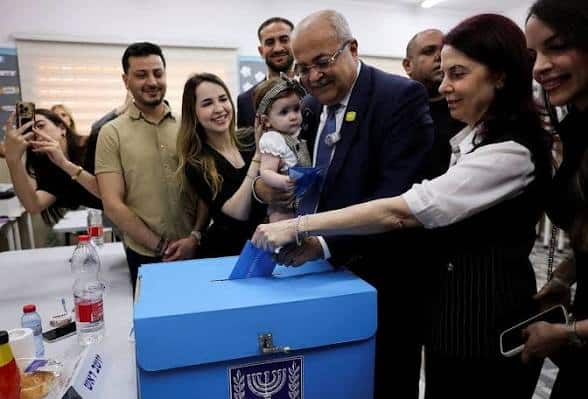
With 90 percent of the ballots counted following Tuesday’s national election, Israel faces a deep political deadlock. Neither the ruling coalition led by Prime Minister Benjamin Netanyahu nor the opposition bloc led by Gadi Eisenkot has secured the 61-seat Knesset majority required to form a government.
According to preliminary results released by the Israeli Central Elections Committee, Netanyahu’s Likud-led bloc stands at 53 seats, while Eisenkot’s opposition alliance holds 48 seats.
With the primary Zionist blocs falling short, Arab-led political parties—the re-emerged Joint List and Ra’am—have captured a combined 19 seats, positioning them as potential kingmakers in coalition negotiations.
Joint List Re-Emerges Amid Middle East Conflict
Re-formed for the 2026 election against the backdrop of the wars in Gaza and Lebanon, the Joint List—an alliance comprising Hadash, Ta’al, and Balad—is led by Yousef Jabareen.
Focusing heavily on civil equality, worker rights, and combating organized crime within Arab communities, the Joint List’s manifesto calls for an immediate end to military campaigns and a shift toward domestic investment.
Speaking on the election outcome, Jabareen emphasized that the alliance’s primary goal remains removing Netanyahu from power, while noting that partnering with Eisenkot’s bloc presents challenges due to the opposition’s support for ongoing military operations.
Ra’am Maintains Pragmatic Civic Stance
Under the leadership of Mansour Abbas, Ra’am (the United Arab List) has maintained its focus on civic integration and socio-economic improvements for Arab Israelis, particularly Bedouin communities.
Having previously made history by joining Naftali Bennett and Yair Lapid’s coalition government in 2021, Ra’am continues to function as an independent civic party. Abbas signaled an openness to enter talks with anti-Netanyahu forces, stating that participating directly from within the system offers the most effective path toward delivering real structural changes.
The Anti-Arab Veto Barrier
Despite controlling the 19 seats necessary to tip either side past the 61-seat threshold, both Arab factions face long-standing political barriers. An informal “anti-Arab veto” among right-wing and nationalist Jewish-led parties continues to complicate formal coalition building.
While Netanyahu previously described forming a coalition with Arab parties as “a shame and disgrace,” Eisenkot faces resistance from within his own prospective partners regarding formal power-sharing agreements.
If neither major bloc agrees to formal or informal backing from the Joint List or Ra’am, Israel could face another election cycle, leaving Netanyahu in place as caretaker prime minister.