As the new sugar season officially commences, the Government of India has rolled out aggressive measures to keep the market stable and protect consumers from unfair price hikes during the upcoming festive season.
Citing the need to maintain an uninterrupted supply chain, authorities have officially revised stock-holding limits and shortened holding periods for sugar dealers nationwide.
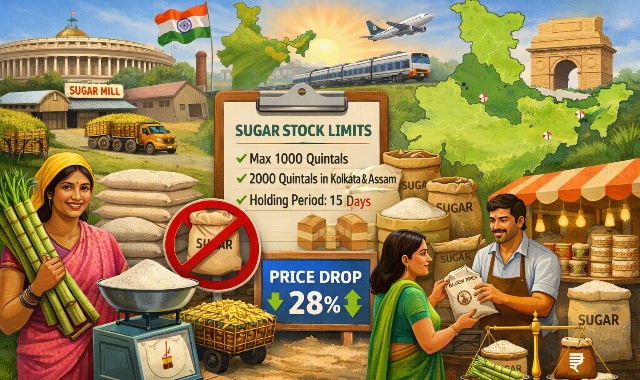
Under the new directives effective from October 15 to November 30, 2026, sugar dealers are legally barred from holding stock for more than 15 days from the date of receipt. Furthermore, inventory caps have been strictly fixed at a maximum of 1,000 quintals at any single place or time across the country.
Recognising distinct geographical and logistical challenges, exceptions have been carved out for specific regions. Kolkata and its extended metropolitan areas, along with the State of Assam, have been granted a higher threshold of 2,000 quintals. Officials noted that Kolkata serves as a critical distribution gateway sourcing from Uttar Pradesh, Maharashtra, and Karnataka for the entire eastern and north-eastern belts, where transportation logistics require higher localised buffers.
Market Relief and Price Redirections
The proactive intervention comes on the heels of positive market corrections. Average retail sugar prices have already registered a notable 15% decline from their August peak. Even more dramatic is the drop in ex-mill sugar prices, which have plummeted by roughly 28% and remained stable over the past three weeks.
The Union Government has strongly urged wholesalers and retailers to pass on these reduced ex-mill rates directly to end consumers without delay. Market participants have been put on notice to keep stocks moving seamlessly, with zero tolerance for artificial scarcity or speculative hoarding.
Balancing Farmers and Consumers
Looking ahead, sugar mills across different agro-climatic zones have been instructed to kick-start crushing operations promptly. Meanwhile, central and state authorities will keep a close watch on weather patterns—particularly potential El Niño impacts—to safeguard both the domestic supply equilibrium and the financial interests of sugarcane farmers.
Reiterating its core economic stance, the government emphasised that sugarcane growers and everyday consumers remain the twin pillars of India’s sugar policy: ensuring fair, remunerative returns for cultivators while keeping essential sweets affordable for households nationwide.