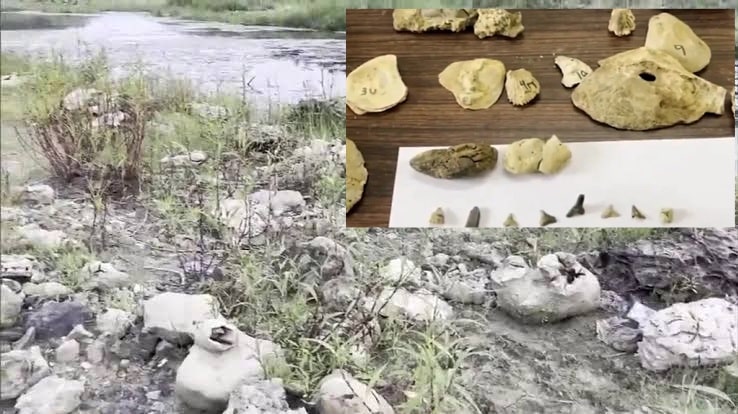
A remarkable fossil discovery in Odisha’s Mayurbhanj district has revealed that present-day Baripada and its surrounding regions were once submerged beneath a shallow sea nearly 15 million years ago.
Researchers have uncovered a collection of marine fossils, including shark teeth, shark vertebrae, fish bones, mollusc shells and microscopic marine organisms, offering valuable insights into Odisha’s prehistoric environment and marine biodiversity.
Discovery Made During Student Field Visit
The fossils were discovered in the Baripada Fossil Bed, which stretches from Dera in the Kuliana block to Pratappur in the Badasahi block of Mayurbhanj district.
According to Dr. Debabrata Nandi, researcher and professor in the Department of GIS at Maharaja Sriram Chandra Bhanja Deo (MSCB) University, the discovery began during a field excursion with students.
While surveying the area, the team noticed unusual fossil-like remains. Local residents referred to the objects as “Asura Hadda” or “demon’s bones,” sparking further scientific investigation.
Subsequent studies confirmed the presence of several marine fossils, including shark teeth and vertebrae, along with other fossilised remains that researchers are still examining.
Evidence of an Ancient Sea in Odisha
Scientists believe the fossils date back to the Miocene Epoch, approximately 15 million years ago, a period known for significant climatic changes and the evolution of diverse plant and animal species.
The discovery strongly suggests that large parts of Baripada and nearby regions were once covered by a shallow marine environment.
Researchers say the presence of shark teeth and other sea-animal fossils provides clear evidence that the area formed part of an ancient coastal or marine ecosystem.
“If it were not a marine belt, we would not have found shark teeth and fossils of marine organisms. Their presence confirms that the sea once existed in this region,” Dr. Nandi explained.
Rich Marine Biodiversity Preserved in Fossils
The fossil collection indicates that the region supported a thriving underwater ecosystem millions of years ago.
Among the discoveries are:
- Shark teeth
- Shark vertebrae
- Fish bones
- Mollusc shells
- Microscopic marine fossils
- Other unidentified fossil remains
Researchers estimate that sharks account for nearly half of the fish fossils recovered from the site, highlighting their dominance in the ancient marine habitat.
Scientists Seek Answers to Ancient Climate Changes
One of the key questions arising from the discovery is why the sea retreated nearly 60 kilometres from present-day Baripada.
Researchers believe climate change, geological shifts or natural disasters may have contributed to the transformation of the landscape over millions of years.
Scientists are calling for extensive geological and climate-based studies to better understand the environmental changes that shaped eastern India’s coastline and ecosystems.
Further research could reveal additional fossil deposits and help reconstruct Odisha’s prehistoric geography.
Potential Geo-Heritage and Tourism Destination
Experts believe the Baripada Fossil Bed has immense scientific, educational and tourism value.
Dr. Nandi has advocated for the site’s conservation and official recognition as a geo-heritage destination.
He suggested developing the area into a fossil park and promoting geo-tourism to attract researchers, students and visitors interested in Earth’s history.
According to researchers, this is currently the only known site in Odisha containing Miocene-era marine fossils, making it a unique geological treasure for the state.
Preserving Odisha’s Prehistoric Legacy
The discovery offers a rare glimpse into Odisha’s ancient past and strengthens understanding of the region’s geological evolution.
Scientists say preserving the fossil site could support future research, promote environmental education and create new tourism opportunities in Mayurbhanj.
As investigations continue, the Baripada Fossil Bed may emerge as one of eastern India’s most important geological heritage sites, helping uncover the story of a prehistoric sea that once covered parts of Odisha.