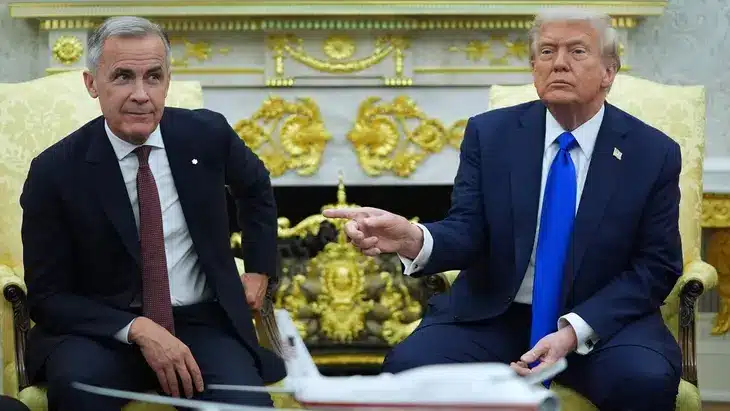
Trade tensions between the United States and Canada have escalated sharply after the US imposed 50% tariffs on Canadian products worth $20 billion, following the failure of last-minute negotiations between the two countries.
Canada swiftly responded to the move, with Prime Minister Mark Carney vowing to match the tariffs and warning that the latest US proposals were unfair and economically damaging.
The latest escalation threatens to further strain a relationship between two of the world’s closest trading partners, whose economies are deeply interconnected.
US says Canada rejected proposed trade deal
US Trade Representative Jamieson Greer said Canada had declined to finalise a trade agreement under terms that Washington said had been agreed earlier in the week.
According to AFP, Greer said the US had also offered to reduce tariffs on sectors including steel and aluminium, but negotiations nevertheless failed to produce an agreement.
The tariff decision followed an extension granted by US President Donald Trump to give the two sides additional time to reach a deal. Despite the extra three days, the negotiations ended without an agreement.
Trump had earlier said the US “should be able to have a deal with Canada”, pointing to his relationship with Carney.
Carney calls US terms ‘unfair’
Carney pushed back against Washington’s position, saying last-minute changes to the proposed US terms made the agreement unacceptable.
“Last-minute changes in the US proposed terms were unfair, uneconomic, and called into question the reliability of any deal,” Carney said.
The Canadian prime minister also said his government would announce additional support for Canadian workers and businesses in the coming days.
Canada has been particularly seeking relief from US tariffs affecting automobiles, steel and aluminium, which Ottawa says have contributed to economic pressure and job losses.
Carney promises to match US tariffs
Canada’s response could deepen the trade confrontation, with Carney vowing to match the US tariffs “dollar for dollar.”
The dispute comes as Canada reassesses its heavy dependence on the US market. The United States accounts for roughly 70% of Canadian exports, making the latest tariff escalation particularly significant for Canadian businesses.
Carney has repeatedly argued that Canada’s relationship with the US has undergone a lasting change and said the country needs to diversify its trading relationships.
$880 billion trade relationship at risk
The economic stakes are substantial. The US and Canada exchanged around $880 billion worth of goods and services last year, highlighting the scale of their commercial relationship.
The two countries also share a 5,525-mile border, which remains largely undefended.
Nearly 330,000 people and goods worth about $2 billion cross the border every day, while approximately 800,000 Canadians live in the United States.
The tariffs could therefore have consequences extending well beyond individual industries, potentially affecting businesses, consumers and supply chains on both sides of the border.
Long-running trade tensions
The latest dispute adds another chapter to a history of trade disagreements between Washington and Ottawa.
The two countries have previously clashed over issues including Canadian softwood lumber exports and US access to Canada’s protected dairy market.
Despite such disputes, the US and Canada have maintained close economic, political and security ties for decades.
The latest tariff escalation, however, signals a growing strain in that relationship as Ottawa seeks greater economic independence from its southern neighbour.
What happens next?
With Canada threatening retaliatory tariffs and the US maintaining its tougher trade stance, businesses on both sides now face increased uncertainty.
For Canada, the immediate challenge will be limiting the economic impact of the tariffs while protecting domestic industries and workers. At the same time, Ottawa is expected to accelerate efforts to diversify its exports and reduce its reliance on the US.
For Washington, the dispute raises questions over how far its tariff strategy can go without disrupting the deeply integrated North American supply chains that connect the two economies.
The failure of the latest negotiations means the US-Canada trade dispute is likely to remain a major economic and political issue in the weeks ahead.