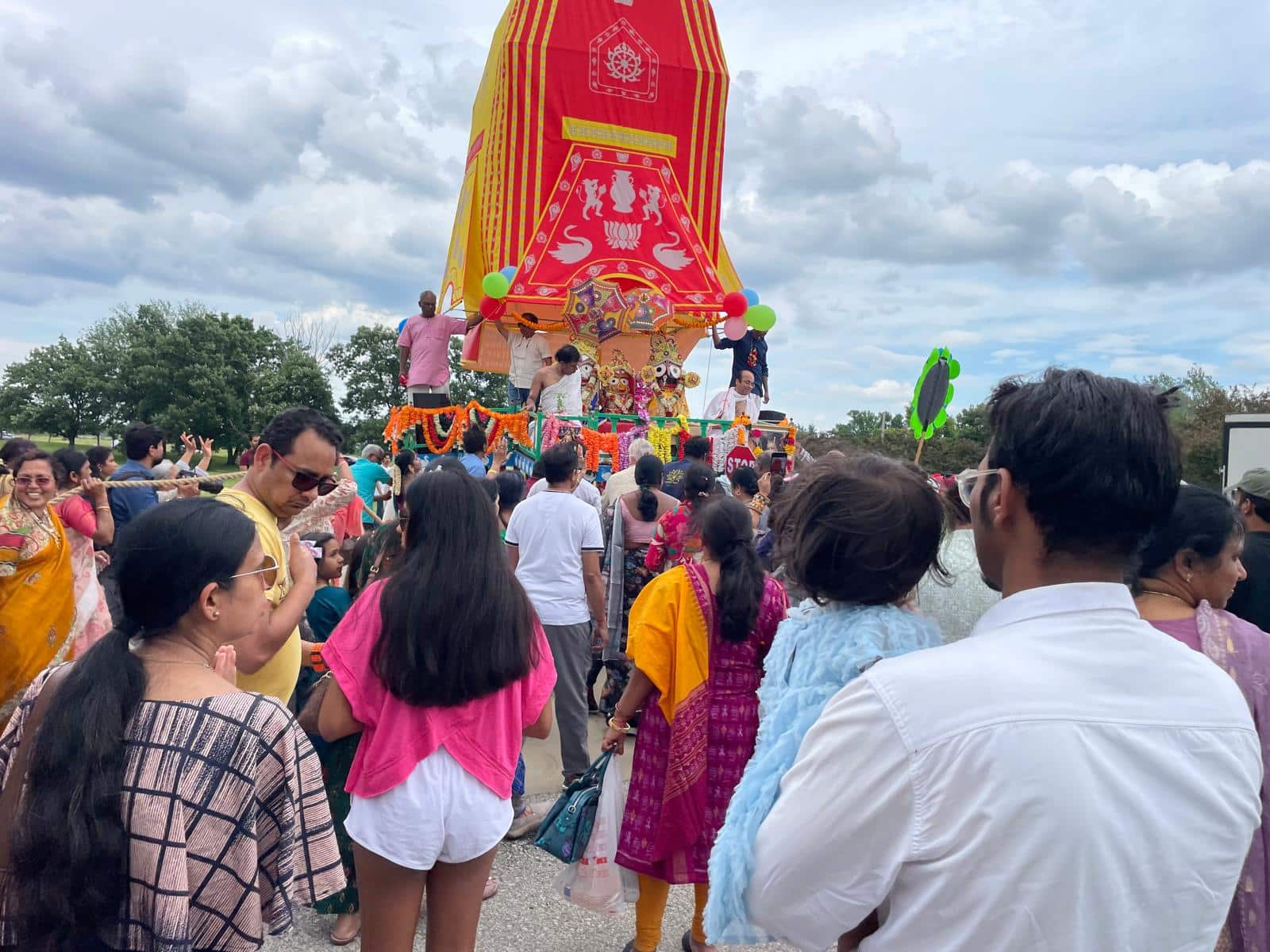
On June 7, 2026, ISKCON St. Louis held its public celebration of the Jagannath Rath Yatra, drawing crowds of devotees and curious onlookers to Lindell Boulevard. What might have been a joyous procession, however, has sparked deep distress and strong condemnation from thousands of Jagannath devotees across the United States and worldwide.
Just two days earlier, on June 5, a formal “Petition of Respectful Protest” signed by Arati Nanda Pati (Houston), Dr. Debananda Pati (Houston), Ajaya K. Mohanty (Falls Church, VA), and many others, was submitted to the temple president and management committee of ISKCON St. Louis.
The petition, accompanied by extensive scholarly documentation, urged the temple to postpone the festival and observe it only during the scripturally ordained nine-day period (Navadinatmaka Yatra) from July 16 to July 24, 2026.
“Untimely” Rath Yatra
According to authoritative scriptures cited in the petition—including the Skanda Purana (Purushottama-kshetra Mahatmyam), Brahma Purana, Padma Purana, and Neeladri Mahodaya—Lord Jagannatha’s Ratha Yatra is a precisely timed nine-day festival that begins on Ashadha Shukla Paksha Dvitiya and concludes with Bahuda Yatra on Dashami. These dates are not cultural suggestions but “divine injunctions” proclaimed by Lord Jagannath Himself during His installation by Lord Brahma, as detailed in the Puranas.
Scholars appointed by the Shree Jagannatha Temple Administration (SJTA) in Puri, whose final opinion was formally approved by the Gajapati Maharaja of Puri and the Temple Managing Committee on September 3, 2025, have declared the tithis (lunar dates) “inviolable.” Practical adaptations in the manner of celebration are allowed, but the sacred tithi itself cannot be changed for reasons of geography, convenience, or local circumstances.
The petition’s attached “Untimely Ratha-Yatra – A Brief Note” and the full 2025 SJTA scholarly response further explain that ISKCON’s long-standing practice of holding the festival on weekends or convenient dates outside India constitutes a departure from both scripture and the unbroken tradition observed for centuries at Puri, the moola-peetha (original seat) of Lord Jagannatha.
ISKCON’s Position vs. Puri’s Verdict
Internal ISKCON documents referenced in the attachments reveal that after years of dialogue, the organisation’s Governing Body Commission decided in October 2025 to observe the correct tithis within India but to continue flexible dates for centres abroad. The Puri scholars and Gajapati Maharaja have firmly rejected this distinction, stating that the Divine Commandment of Lord Jagannath applies universally—whether in Puri, India, or St. Louis, USA.
In a strongly worded letter dated September 6, 2025, Gajapati Maharaja Dibyasingha Deb urged ISKCON’s GBC Chairman to ensure all global centres immediately align with the scriptural dates, calling continued deviation “a breach of sacred scripture, Divine Commandment, and ancient tradition” that hurts the religious sentiments of millions of devotees.
A Respectful Yet Firm Appeal
The petitioners emphasised they are not adversaries of ISKCON. “We offer this representation with humility, devotion, and sincere appreciation for ISKCON’s invaluable contribution in spreading Krishna consciousness,” the petition states. Yet they argue that celebrating Rath Yatra more than a month early transforms a sacred divine observance into a “cultural event of convenience,” undermining the authenticity of one of Hinduism’s most revered festivals.
The document also notes that other major Hindu festivals—Janmashtami, Rama Navami, Ganesh Chaturthi, Mahashivaratri, Diwali—are observed worldwide strictly according to their prescribed tithis, regardless of location. The same principle, devotees insist, must apply to Lord Jagannatha’s Ratha Yatra.
What Happens Next?
As the Ratha Yatra chariots rolled through St. Louis streets on June 7, devotees who signed the petition expressed sorrow rather than anger. Many are now calling on ISKCON leadership globally to reconsider its 2027 and beyond policy, urging unity with the living tradition of Shree Jagannath Dham in Puri.
Whether this controversy leads to broader dialogue or deeper division remains to be seen. What is clear is that for millions of Jagannath devotees, the date of Ratha Yatra is not merely logistical—it is an act of surrender to the Divine Will as revealed in shastra and preserved for millennia in the holy land of Puri.