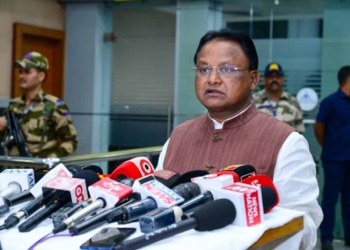
In a powerful and unflinching address that has sent ripples across Odisha, Revenue and Disaster Management Minister Suresh Pujari has described the case of Jitu Munda — a tribal man from Dianali village in Patna block of Kendujhar district — as a chilling example of how the state’s administrative machinery is crumbling from within.
Munda’s sister had died. When he approached the bank for the necessary formalities, an officer demanded a death certificate. Unable to understand or procure the complex paperwork, the tribal man took a step born of sheer desperation and dignity: he carried his deceased sister’s body to the bank as living proof.
“This is not an isolated tragedy. This is the face of a system that is rotting,” Pujari declared at the foundation day discussion forum organised by Pragativadi. “Educated, influential people are the ones hollowing out the system. A simple Adivasi should not have to prove a death by carrying a body. Officials were supposed to help him get the certificate. They failed him.”
Pujari urged immediate reform and called on Pragativadi to sharpen its voice against such injustice. “Just as it has become the voice of the people, it must now turn this dysfunction into a national conversation — not monologue, but real dialogue,” he said.
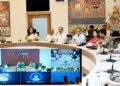
The event, held at Pragativadi’s office, was inaugurated by former Chief Minister Dr Giridhar Gamang. In a moving moment, Gamang conferred the Pragativadi Janaseva Samman on Padmacharan Nayak, a veteran politician active since the 1960s, former legislator, and torchbearer of the anti-liquor movement.
The gathering turned into a rare, candid retrospective on Odisha’s political journey titled “Odisha Politics: Past, Present and Future.” Several stalwarts shared the stage and their unvarnished views:
Former Union Minister Srikant Jena recalled how Pradyumna Bal, the founder of Pragativadi, launched the newspaper with uncompromising values and a commitment to ordinary citizens. “He didn’t stop at journalism — he also created KIIT and KIIS institutions that today stand at par with global standards in technical education,” Jena noted.
Former Finance Minister Panchanan Kanungo said Pragativadi was born out of a political movement and had nurtured countless leaders who later became MLAs, MPs, ministers and Union ministers. “At a time when every government decision seems to leave people bewildered, a sharp, fearless newspaper like this is more necessary than ever,” he observed.
Former Minister Amar Prasad Satpathy painted a stark contrast: “In Pradyumna Bal’s time, people entered politics to serve. Today, they come for profit and greed. The system has become diseased. There is no clear roadmap for development despite tall talk of a developed Odisha by 2036.”
BJD Coordination Committee Chairman Debi Prasad Mishra added: “Politics without stability and efficiency cannot be people-centric. We talk of semiconductors, yet companies are leaving Odisha. We need a concrete, time-bound action plan for 2036 — not slogans.”
In a special announcement, Pragativadi Executive Editor Birupakshya Tripathy declared that the newspaper would now document Odisha’s political history in book form. The first volume will be released on November 8 — Pradyumna Bal’s birth anniversary.
The foundation day also celebrated unsung heroes. The Pragativadi Shram Samman was conferred on Rahasbihari Nayak of Nayagarh, a sanitation worker who has served with dedication for 35 years. Other distinguished personalities honoured included Shishir Kumar Nayak of Jajpur, Santosh Kumar Das of Bhadrak, Bhubaneswar Mayor Sulochana Das, and Rabi Samal of Kendrapara for their contributions in public life and journalism.
Pragativadi Chairperson Saswati Bal, while felicitating the guests, thanked everyone and said, “My team worked tirelessly to make this possible. I want Pragativadi always to discuss the issues that matter to society, keep the concerns of ordinary people at the forefront, and show the system the right path.”
What began as a foundation day celebration has become a powerful mirror held up to Odisha’s governance — forcing both politicians and citizens to confront uncomfortable truths about bureaucracy, political decay, and the urgent need for change.