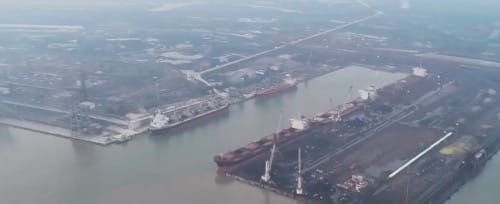
Paradip Port Authority has completed a ₹352 crore capital dredging project that gives the eastern Indian port an 18.5-metre deep-draft capability, allowing fully laden Capesize bulk carriers to enter its inner harbour for the first time.
The dredging forms the centrepiece of a ₹427.80 crore package of seven infrastructure projects inaugurated on 21 August 2026 by Union Minister for Ports, Shipping and Waterways Sarbananda Sonowal. The remaining works in the package include a ₹24.89 crore three-lane bridge over Atharbanki Creek, an advanced vessel traffic management system, piped natural gas supply for residential quarters, and other connectivity and administrative upgrades.
The deeper draft is expected to improve economies of scale for high-volume dry bulk cargo such as coal, iron ore and coking coal. Capesize vessels, among the largest bulk carriers in global trade, can now call at the inner harbour without the previous constraints of partial loading or reliance on lighterage arrangements. Port officials say the change should support higher cargo parcels per voyage, shorter vessel turnaround times and lower logistics costs for industries in eastern India.
Alongside the inaugurated projects, Paradip Port Authority signed concession agreements worth ₹1,580.36 crore for three berth mechanisation schemes. These cover a 5 million tonnes per annum (MTPA) South Quay facility, an 8 MTPA multipurpose berth and a 10 MTPA captive berth. The agreements are part of the port’s plan to raise berth mechanisation from the current level of about 80 per cent to 100 per cent by 2030.
The infrastructure push follows a record operational year. Paradip handled 156.45 million metric tonnes (MMT) of cargo in FY 2025–26, its highest ever and a 4.02 per cent increase over the previous year. The volume placed it as the second-largest major port in India by cargo throughput and the leading major port on the east coast. Coastal cargo accounted for a substantial share of the total.
In early September 2026, the port handled its first Capesize vessel at a 16.5-metre draft—the MV Mineral Kwangyang, carrying 152,702 metric tonnes of coking coal—providing an early demonstration of the deeper-water capability ahead of full utilisation of the 18.5-metre draft.
Sonowal, speaking at the August inauguration, described the investments as a growth multiplier for eastern India, citing deeper drafts, improved connectivity and greater mechanisation as factors that should strengthen trade, logistics and employment in the region. The port has also set a longer-term target of expanding capacity significantly by 2047 as part of broader national maritime goals.
The October promotional update from the port authority reiterated the deep-draft milestone and its expected benefits for mineral, energy and industrial cargo flows. With the dredging complete and additional mechanisation projects under concession, Paradip is positioning itself to handle larger vessels more efficiently while competing for bulk cargo that previously faced draft limitations at the port.