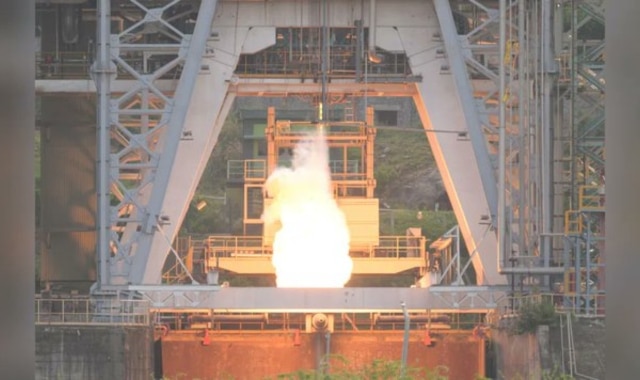
India’s space program reached a significant milestone as ISRO successfully conducted a hot test of its semi-cryogenic engine power head at the ISRO Propulsion Complex (IPRC) in Mahendragiri.
The test achieved 175 tons of thrust, which is 88% of the engine’s maximum capacity of 200 tons.
This marks the eighth test in the series. Earlier trials were conducted at 47% and 60% thrust levels. The latest test demonstrated the engine’s ability to scale up to higher thrust, though ISRO has not revealed the duration of the firing. A functional semi-cryogenic engine must sustain firing for 120 to 360 seconds, but so far, ISRO has tested its components for less than five seconds in each trial.
The semi-cryogenic engine, designated SE-2000, is expected to power India’s future heavy-lift launch vehicles. Once fully developed, it will enhance payload capacity and reduce launch costs by using kerosene as fuel instead of liquid hydrogen.
ISRO officials confirmed that the next test could target 100% thrust, a crucial step toward validating the engine’s design. However, experts caution that a flight-ready engine may still take years, given the need for long-duration tests and integration with other systems.