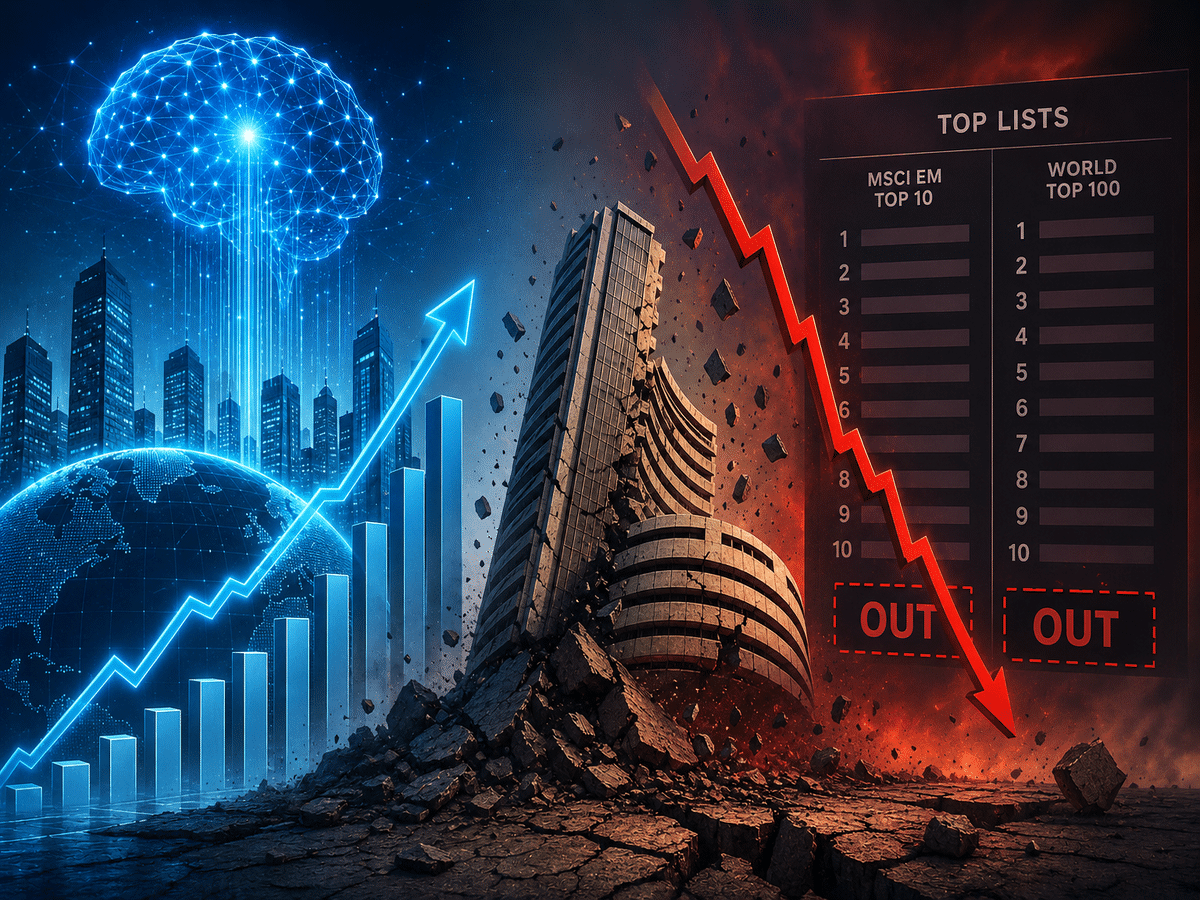
In a significant development for India’s financial markets, the country has dropped out of the top 10 constituents of the MSCI Emerging Markets (EM) Index for the first time in more than two decades.
The shift marks a major change in global investment trends and could influence how billions of dollars in international capital flow into emerging economies, including India.
No Indian Company in MSCI EM Top 10
For the first time since at least 2000, no Indian company features among the top 10 constituents of the MSCI Emerging Markets Index, one of the world’s most influential investment benchmarks.
India’s largest index components, HDFC Bank and Reliance Industries, have slipped to the 11th and 12th positions respectively after previously ranking among the top 10.
Their individual weight in the index has fallen below 0.8%, contributing to India’s overall decline in the benchmark.
India’s Weight Drops to Six-Year Low
India’s overall share in the MSCI Emerging Markets Index has dropped to 10.87%, its lowest level in six years.
The decline is particularly notable because India had reached a record weight in 2024 and briefly emerged as the largest component in MSCI’s EM Investable Market Index before China regained the top position.
Market analysts attribute the latest shift largely to global investors moving capital toward technology and artificial intelligence-driven companies.
Why the MSCI EM Index Matters
The MSCI Emerging Markets Index serves as a key benchmark for global investors and influences how massive pools of money are allocated across developing economies.
More than $700 billion in passive funds, including exchange-traded funds (ETFs) and index funds, track the index directly. Overall assets benchmarked to MSCI’s emerging market indices exceed $1.8 trillion.
When a country’s weight in the index declines, passive funds are required to reduce their exposure accordingly during scheduled rebalancing exercises.
As a result, lower index weight can translate into reduced foreign investment flows into that country’s stock market.
Impact on Foreign Investors and Active Funds
The decline also affects actively managed funds.
Fund managers often compare their portfolios with the MSCI benchmark. When India’s weight in the index falls, global investors can reduce their India exposure without appearing significantly underweight compared to the benchmark.
This can reduce the attractiveness of Indian equities in global portfolios and potentially impact capital inflows.
Domestic Market Facing Additional Pressure
The index downgrade comes at a time when domestic investment sentiment has also weakened.
According to industry data, equity mutual fund inflows fell sharply in May, reaching their lowest level in a year as investors remained cautious amid volatility linked to geopolitical tensions in West Asia.
Small-cap, mid-cap, and large-cap equity funds all recorded substantial declines in fresh investments.
Higher crude oil prices have added further pressure on investor confidence and market stability.
Rising Oil Prices Creating Economic Challenges
India, one of the world’s largest crude oil importers, remains highly vulnerable to rising energy costs.
Expensive crude oil increases the country’s import bill, widens the current account deficit, and puts pressure on foreign exchange reserves.
To address these concerns, the government has taken several measures, including increasing import duties on gold and introducing policies aimed at attracting foreign capital.
Government Introduces Measures to Boost Foreign Investment
In response to growing economic pressures, the Centre recently announced a series of reforms designed to attract overseas investment.
These include:
- Tax exemptions for foreign portfolio investors on certain government securities.
- Expansion of bond categories available to foreign investors.
- Introduction of special foreign currency deposit schemes supported by the Reserve Bank of India.
The measures are aimed at strengthening foreign capital inflows and supporting economic stability amid global uncertainty.
What Lies Ahead for India
While India’s removal from the MSCI Emerging Markets top 10 highlights changing global investment patterns, experts believe the country’s long-term growth story remains intact.
However, maintaining investor confidence, attracting foreign capital, and navigating global economic challenges will remain crucial in the coming months.
As international markets continue to evolve, India’s ability to adapt and sustain economic momentum will determine whether it can regain a stronger position in global investment benchmarks.