Despite years of schemes, funding from both the Centre and state governments, and the ambitious target of ranking among India’s cleanest cities under the Swachh Bharat Mission, Bhubaneswar’s streets and open spaces continue to tell a different story. Open garbage dumps, roadside heaps and the routine burning of waste have turned parts of the capital into polluted zones, raising questions about the effectiveness of the Bhubaneswar Municipal Corporation (BMC) and civic infrastructure.
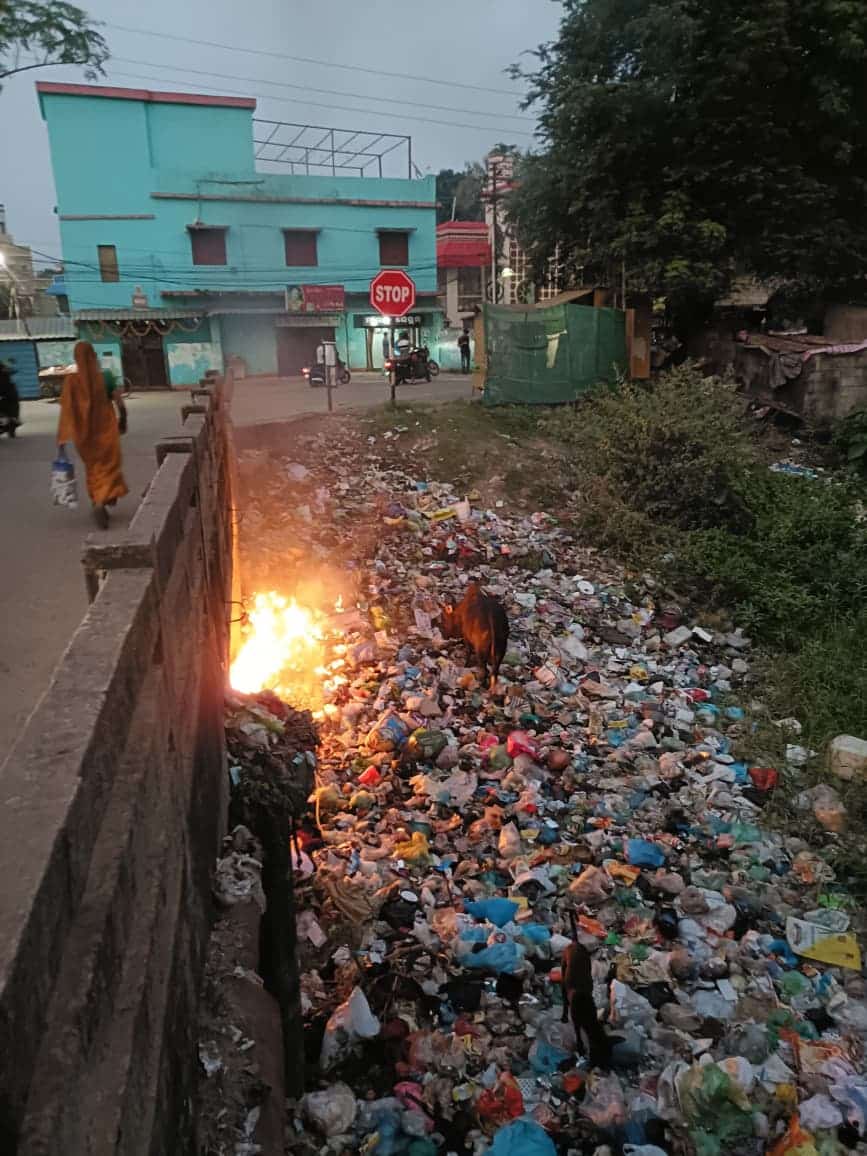
Garbage piles are a common sight along roadsides, vacant plots, near drains and in slum areas. In several places, waste is openly set on fire, releasing smoke and foul odour that pollute the surroundings. Even after BMC workers sweep the roads, the collected garbage often remains unlifted from temporary dumping points. Stray cattle and other animals then scatter it further while searching for food.
Civic awareness campaigns and action against those who dump waste indiscriminately have largely failed. As a result, open spaces have turned into informal dumping grounds. The Daya West Canal stands out as one of the worst affected stretches. Residents regularly dump and burn waste along its banks, turning the canal into a free-for-all garbage site. Local corporator Minushree Khuntia and officials of the BMC’s sanitation wing are aware of the problem, yet no visible corrective measures have been taken. Allegations have also surfaced that little work is progressing on the canal’s restoration.
The Daya West Canal is a major irrigation and drainage channel that runs through the capital. Stretching 34.86 km from Barang to Jatni, about 16.10 km of it passes through BMC limits. The state government has initiated development works for its renovation and the transformation of adjoining areas. However, the canal’s banks have become a preferred dumping site for city residents.

Sanitation workers point to deeper systemic issues. Garbage collection systems remain weak in many wards. BMC lacks adequate vehicles and drivers, and collection trucks do not arrive regularly in several localities. Residents are often forced to dump waste on the roadside. The problem is not confined to one area; it is visible across multiple wards, markets and slums.
BMC does organise occasional cleanliness drives, mechanical sweeping, door-to-door collection and material recovery facilities. Yet the continued open burning of waste and incomplete door-to-door coverage highlight the gap between plans and ground reality. When contacted, Additional Commissioner Subhendu Sahu said he would discuss the matter with Deputy Commissioner N. Ganesha Babu, who was unavailable due to illness.
Achieving a genuinely clean city requires more than machines and staff. It demands sustained citizen awareness, regular monitoring, adequate infrastructure and strict enforcement. As long as garbage continues to pile up in the open, is burnt and cannot be fully cleared even after road sweeping, describing Bhubaneswar as a clean city will remain difficult.
Development of the Daya West Canal could also ease traffic congestion and help in flood control. However, the presence of numerous slums and illegal constructions along both banks means the government will first have to clear encroachments and rehabilitate affected residents.
BDA survey completed, but project remains stuck
Separately, the Bhubaneswar Development Authority (BDA) conducted a special survey for the proposed Daya West Canal road project. The survey identified 3,540 illegal constructions on government land along the canal banks — 2,736 residential houses, 739 commercial establishments or shops, and 65 other structures such as temples, schools, community halls and cowsheds. A drone survey was also carried out to assess the impact of the slums. The project envisages a three-lane road on both sides of the canal, traffic decongestion and beautification, along with rehabilitation of displaced people as per government norms. Despite the survey, the plans currently remain stalled under red tape.