The Government of Odisha has accelerated its blueprint for massive economic transformation, hosting a high-level inter-departmental coordination meeting on the Bhubaneswar-Kataka-Puri-Paradip Economic Region (BKPPER) project.
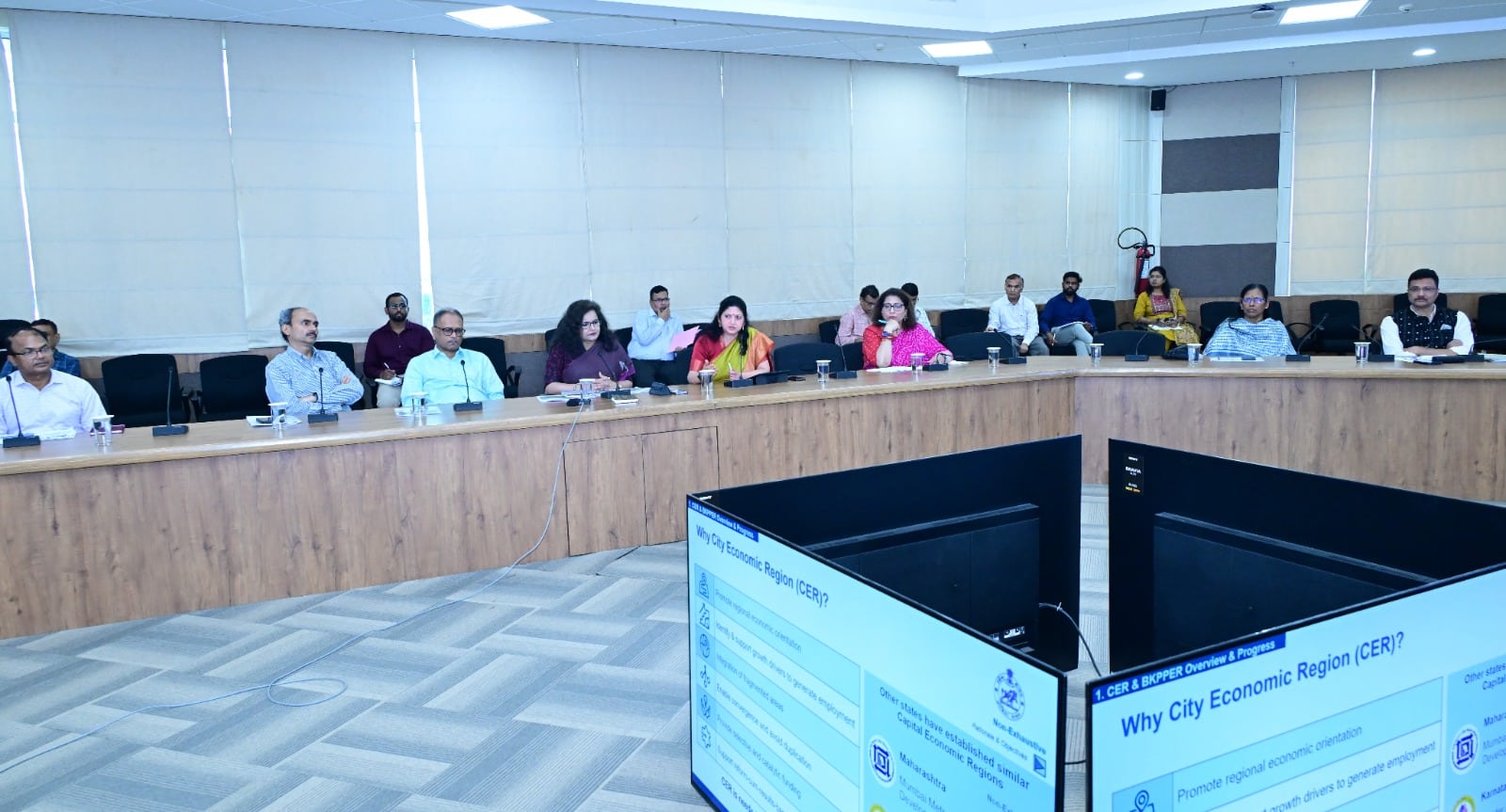
Chaired by Chief Secretary Anu Garg at the Kharavela Bhavan on Sunday, the summit outlined the region’s trajectory as the state’s primary “growth engine” for realizing the ambitious goals of Vision 2036 and 2047.
Development Commissioner and Additional Chief Secretary Deo Ranjan Kumar Singh, alongside top brass from various departments, participated in the strategic review. Chief Secretary Garg emphasized that achieving a global standard of regional development requires a unified, synchronized effort across all government wings to boost infrastructure, investment, and employment.
Additional Chief Secretary of the Housing & Urban Development Department, Usha Padhee, presented the project’s progress and priority areas. She noted that BKPPER is poised to become a global model for sustainable and inclusive economic development, making a significant contribution to the state’s GDP under the ‘Viksit Bharat 2047’ vision. The integrated strategy focuses heavily on multimodal transport, affordable housing, climate-resilient infrastructure, and urban rejuvenation.
A $400 Billion Quad-City Powerhouse
Spanning four districts—Khordha, Kataka, Puri, and Jagatsinghpur—and encompassing 19 urban areas, BKPPER is one of four major pilot projects under the Government of India’s City Economic Region initiative. The master plan capitalizes on the unique strengths of the quad-city region: Bhubaneswar’s IT and technology prowess, Kataka’s traditional commerce, Puri’s tourism and cultural heritage, and Paradip’s port-based industrial and logistics capacity.
The economic targets for the region are unprecedented for the state, aiming to generate over 40 lakh (4 million) non-agricultural jobs and attract upwards of $400 billion in corporate investments.
Execution and Funding
During the secretary-level meeting, officials reviewed 269 specific projects across 19 departments, originally identified in collaboration with NITI Aayog. Discussions focused on inter-departmental synergy, project mapping on the PM Gati Shakti portal, and future action plans. To financially back this massive undertaking, the Asian Development Bank (ADB) has been proposed as a funding partner.
To ensure seamless execution, the state cabinet recently approved the creation of the Capital Economic Region Development Authority (CERDA). This dedicated institutional framework will guarantee integrated regional management, overseeing everything from urban planning and project implementation to financing and investment mobilization across the BKPPER zone.