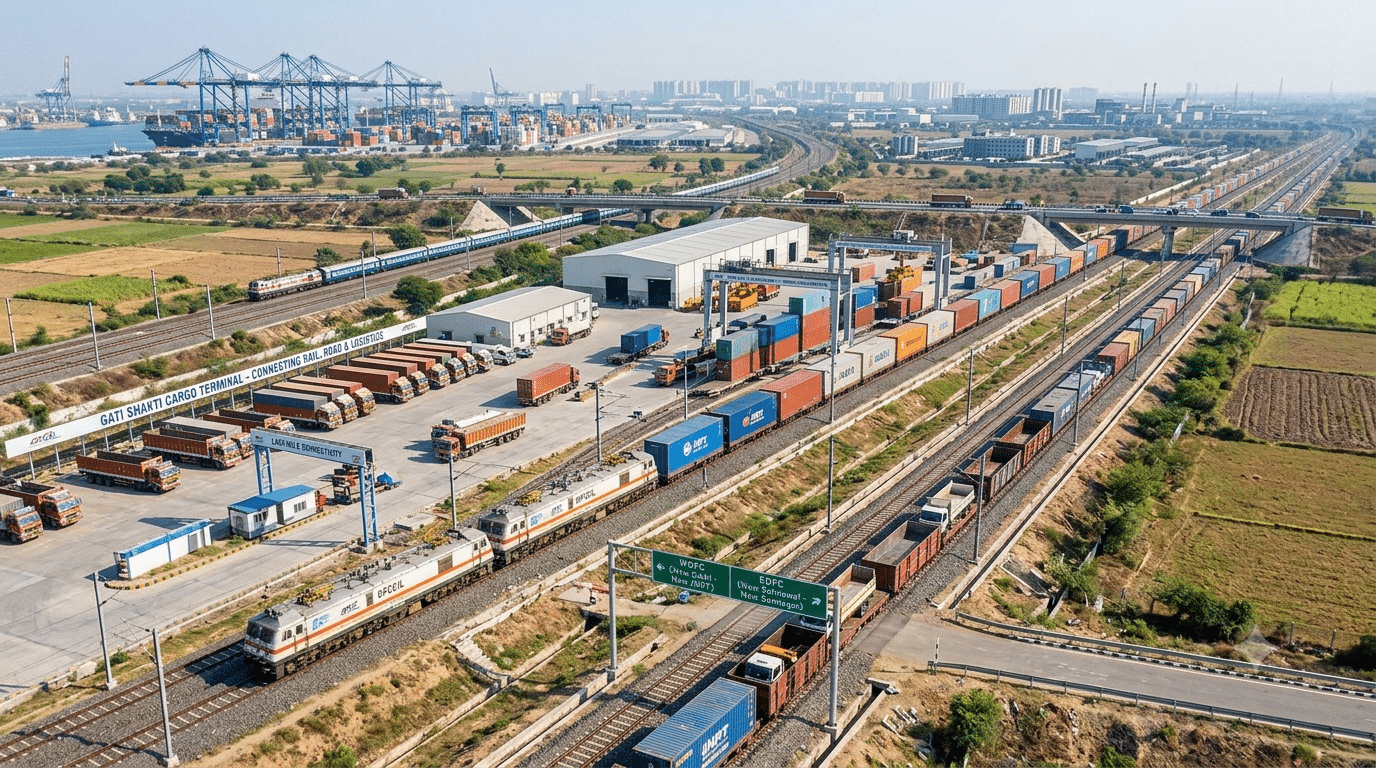
In a major push toward building a high-capacity, efficient, and rapid logistics ecosystem, Indian Railways is expanding its Dedicated Freight Corridor (DFC) network.
The strategic expansion aims to seamlessly link the nation’s key industrial hubs, manufacturing hubs, mineral belts, and maritime ports.
Currently, the operational DFC network comprises two massive trunk lines: the 1,337-km Eastern Dedicated Freight Corridor (EDFC), stretching from New Sahnewal in Punjab to New Sonnagar in Bihar, and the 1,506-km Western Dedicated Freight Corridor (WDFC), connecting New Dadri in Uttar Pradesh to New JNPT in Maharashtra. Together, these two arteries form a 2,843-km high-capacity freight rail grid.
By siphoning heavy freight trains off legacy tracks onto purpose-built corridors, the network has dramatically reduced congestion on conventional routes, enabling faster freight transit while creating crucial operational capacity for passenger services.
The Dankuni–Surat Link: Bridging East and West
Marking a major leap forward in network expansion, Indian Railways has proposed the 2,052-kilometer Dankuni–Surat Dedicated Freight Corridor.
Traversing six major states—West Bengal, Odisha, Chhattisgarh, Madhya Pradesh, Maharashtra, and Gujarat—the proposed corridor will establish an uninterrupted, heavy-haul freight link between the industrial and mining centers of eastern India and the major commercial and port gateways of the west.
Odisha: Unlocking a Mineral and Industrial Powerhouse
The proposed Dankuni–Surat DFC holds transformative potential for Odisha. As a national leader in mining, minerals, steel, power, and heavy manufacturing, the state generates enormous volumes of outbound freight heading to markets across the country.
Key benefits for Odisha include:
- Direct Western Market Access: Provides local steel, aluminum, and mineral producers with a high-speed freight channel to western industrial clusters and export ports.
- National Logistics Integration: Deepens Odisha’s integration into the national supply chain network, driving regional manufacturing growth.
- Rail Network Relief: By absorbing heavy bulk freight traffic, the corridor will relieve pressure on Odisha’s existing, highly congested mixed-traffic lines.
- Dual Operational Boost: De-congesting legacy tracks will improve punctuality and allow capacity expansion for both passenger trains and localized freight.
Speed, Capacity, and Sustainable Growth
Engineered to support heavy-axle loads and double-stack container trains, the DFC infrastructure dramatically increases cargo volume per train shipment.
The shift to dedicated rail freight is projected to lower overall national logistics costs, trim transit times, enhance supply chain predictability, and encourage a modal shift from road to eco-friendly rail transport—a key step toward lowering transport-sector carbon emissions.
With 2,843 km of operational corridors already serving as the backbone of national freight movement, the inclusion of the 2,052-km Dankuni–Surat line marks a defining milestone. By placing Odisha at the intersection of India’s emerging multimodal logistics grid, the project cements the state’s role as a primary driver of the nation’s economic and industrial future.