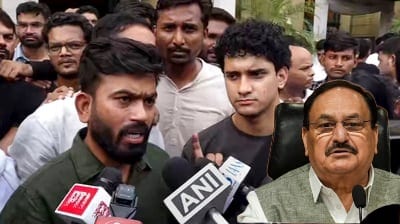
CJP founder Abhijeet Dipke has questioned the government over Union minister JP Nadda’s recent meeting with representatives of the ‘Reservation Hatao Andolan’, seeking clarity on the Centre’s position on caste-based reservations.
Dipke took to X after Nadda held what he described as a “cordial discussion” with members of the group on Thursday. The meeting came days after a protest at Delhi’s Jantar Mantar demanding changes to the country’s reservation system.
“What does the Prime Minister have to say about the movement of 21 August, whose name Mr Nadda is not taking? The country wants to know,” Dipke wrote on X.
His remarks came as the government’s engagement with the protesters triggered questions from opposition voices and others over the nature of the discussions.
Why is Abhijeet Dipke questioning Nadda?
Dipke questioned why Nadda did not explicitly refer to the ‘Reservation Hatao Andolan’ while describing the meeting.
The CJP founder also sought to know Prime Minister Narendra Modi’s position on the movement and its demands.
The Aam Aadmi Party also raised questions over the meeting. AAP Delhi unit president Saurabh Bharadwaj wrote on X that the BJP’s Savarna Morcha movement had raised the issue of reconsidering reservations and asked for greater clarity on the matter.
What did JP Nadda say?
Nadda said the meeting followed the August 21 movement at Jantar Mantar and was held according to a pre-determined schedule.
“Following the movement that took place at Jantar Mantar on 21 August, cordial discussions were held, as per the pre-determined schedule,” Nadda said.
He identified the participants as Harsh Dubey, Ran Bahadur Singh Chauhan and Mrityunjay Pathak and added that another meeting would be held soon.
Nadda, however, did not provide details of the discussions or disclose the venue where the meeting took place.
What happened during the August 21 protest?
Delhi witnessed demonstrations on August 21 after supporters of the ‘Reservation Hatao Andolan’ gathered at Jantar Mantar despite not having permission to hold the protest there.
Delhi Police had reportedly permitted the protesters to gather at Ramlila Maidan instead. Several protesters were detained after gathering at Jantar Mantar, while police and paramilitary personnel were deployed in large numbers.
The demonstration focused on demands for changes to caste-based reservation policies.
What are the protesters demanding?
The protesters have called for caste-based reservations to be scrapped or substantially reviewed, arguing that economic circumstances should play a greater role in determining eligibility for government support.
They have also called for a stronger creamy-layer criterion or greater income-based exclusion within reserved categories.
Other demands include expanded scholarships, fee assistance, coaching and educational support for economically weaker sections.
The group has also sought a review of reservation provisions affecting Scheduled Castes, Scheduled Tribes and Other Backward Classes, including policies concerning higher education.
The protesters have additionally raised concerns regarding the Scheduled Castes and Scheduled Tribes (Prevention of Atrocities) Act and aspects of the University Grants Commission framework.
Government talks put reservation debate in focus
The meeting between Nadda and representatives of the protest movement has brought the contentious issue of reservation back into the political spotlight.
While Nadda has indicated that further discussions are planned, the government has not publicly announced any policy decision arising from the meeting.
Dipke’s demand for clarity from the Prime Minister, meanwhile, adds another political dimension to the debate over the future of reservation policies in India.