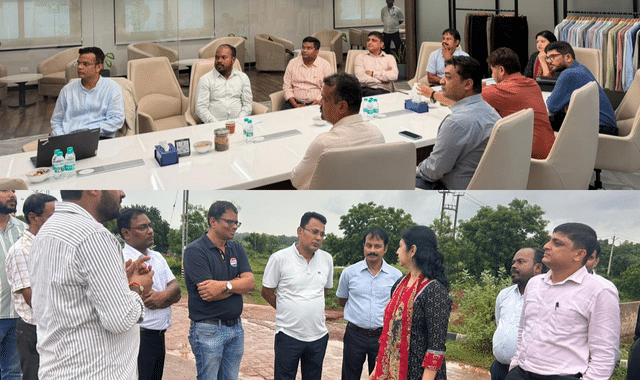
Two industrial estates on the outskirts of Bhubaneswar are being asked to grow up fast. On Sunday, Additional Chief Secretary (Housing & Urban Development) and IDCO Chairperson, Usha Padhee, IAS, walked the ground at Kalibeti and Mudamba in Khordha district and left officials with a simple instruction: stop treating master plans as drawings. Turn them into working factories, working water systems and working buses — on a clock.
Accompanied by Chief General Manager (Land) Saroj Sahu, the land officer and senior field staff, ACS Padhee reviewed plot allocation, land development and the state of roads, utilities and other works. Kalibeti is already billed as a textile and apparel cluster, with names such as MAS Holdings, EPIC and Indian Stitches in the pipeline and tens of thousands of jobs expected — a large share of them for women. That fact shaped the inspection as much as the earthworks did.
“Our focus should be on converting planned industrial infrastructure into functional, investor-ready ecosystems within clearly defined timelines,” she said. “Every component — from land and utilities to mobility and environmental sustainability — must be planned and executed in an integrated manner.”
The message to IDCO divisions was operational, not rhetorical. Identify bottlenecks in land, power, water and supporting infrastructure. Fix them together. Monitor on site, not only on paper. Prospective units, she said, should not lose months waiting for a drain, a transformer or a last-mile road.

Water first, not as an afterthought
Padhee ordered rainwater harvesting and recycling to be built into the core layout of both estates, not added later as a compliance sticker. New industrial areas, she argued, cannot treat water as an infinite municipal gift. Capture monsoon runoff, recycle process and domestic water, and design the estates so conservation is cheaper than waste.
The commute is part of the factory
The other half of the brief was people. She asked authorities to extend Ama Bus — Odisha’s public bus network run under the Housing and Urban Development umbrella — to Kalibeti and Mudamba. For apparel and textile floors, where women often form the bulk of the workforce, a late shift without a safe bus is not a transport footnote. It is a reason not to take the job.
“Industrial growth must be inclusive,” Padhee said. “When we plan an industrial estate, we must plan not only for investors and industries but also for the people who will work there. Safe and dependable public transport, especially for women workers, is an important part of building a modern and inclusive industrial ecosystem.”
Better buses, she added, would also open the estates to workers from surrounding villages and towns — turning industrial land into a regional employment catchment, not a gated island.
One plan, many desks
She closed by demanding tighter coordination across IDCO divisions and other agencies so that land, utilities, roads and transit move in the same week, not in separate calendars. Regular field inspections, she said, should be the rule until the estates match the approved plan and the promised timeline.
The visit fits a wider IDCO push: more developed land, faster handovers, and industrial parks that are meant to be occupied, not merely inaugurated. At Kalibeti and Mudamba the test is now specific. Plots must become plants. Stormwater must become a system. And the women who will stitch, pack and run those plants must have a bus that actually stops at the gate.