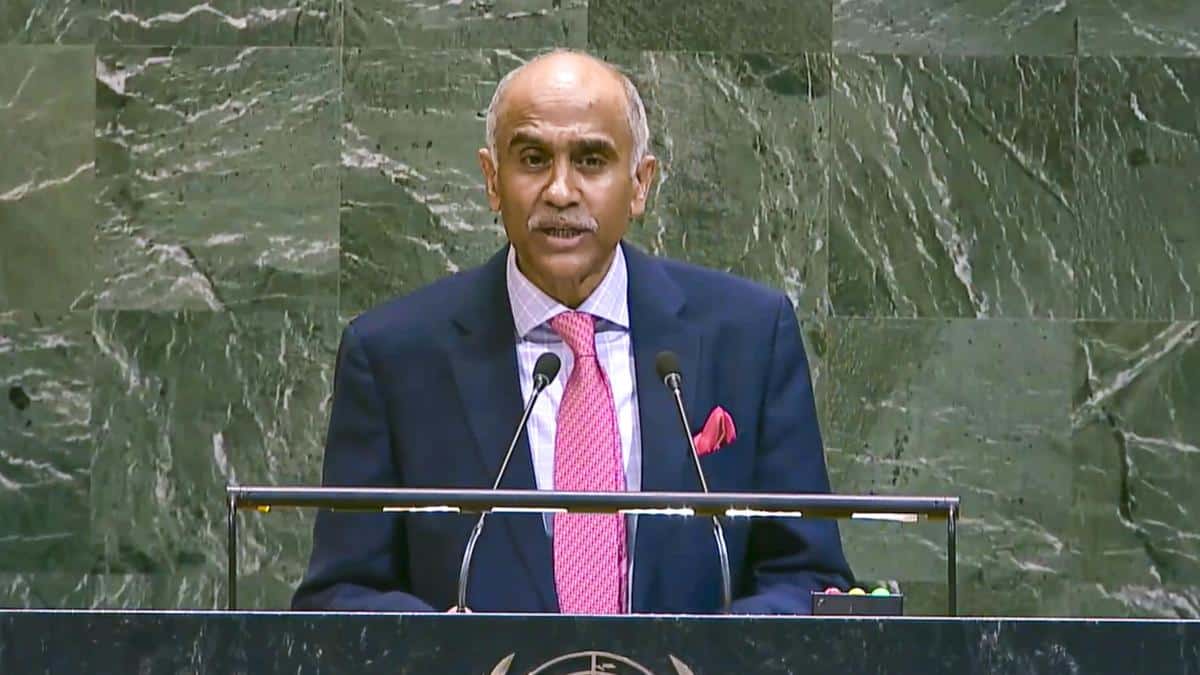
India launched a strong diplomatic attack on Pakistan at the United Nations Security Council (UNSC), condemning Islamabad’s use of the term “Fitna al-Hindustan” to describe certain groups and accusing it of running a state-sponsored campaign of misinformation and hostility against India.
India’s Permanent Representative to the United Nations, Ambassador Harish Parvathaneni, delivered a sharp rebuttal during a UNSC meeting, describing the move as an attempt to cloak propaganda in religious terminology.
India Rejects Pakistan’s Narrative
Addressing the Security Council, Ambassador Parvathaneni said Pakistan’s actions reflected a deliberate strategy to spread misinformation and sustain anti-India sentiment among its citizens.
“This is nothing but officially sponsored misinformation and disinformation dressed in religious terminology,” he said.
The Indian envoy further alleged that the narrative was being promoted by Pakistan’s deep state to divert public attention from pressing domestic challenges.
“It is an outcome of an organised factory of hate coming from the deep state of Pakistan, which aims to keep its citizens in a state of permanent hostility with India in order to perpetuate its control over power and resources while distracting attention from core political and economic problems,” he stated.
What Is ‘Fitna al-Hindustan’?
Pakistan formally designated terrorist groups operating in Balochistan as “Fitna al-Hindustan” in 2025, alleging external involvement in insurgent activities within the province.
India has consistently rejected such accusations and has repeatedly stated that Pakistan uses anti-India narratives to deflect attention from internal security, governance and economic challenges.
At the UNSC, India dismissed the terminology as a politically motivated attempt to frame domestic issues through a religious lens.
India Raises Concerns Over Pakistan’s Military Influence
During his remarks, Ambassador Parvathaneni also referred to what he described as the growing influence of Pakistan’s military establishment in the country’s governance structure.
His comments came in the context of recent constitutional changes in Pakistan and the appointment of General Asim Munir as the country’s first Chief of Defence Forces (CDF) under a newly created military command framework.
Without naming individuals directly, the Indian representative suggested that developments in Pakistan reflected increasing military dominance over civilian institutions.
Criticism Over Pakistan’s Afghanistan Operations
India also criticised Pakistan’s military operations in Afghanistan, alleging that cross-border strikes had resulted in civilian casualties.
“Dressing up a massacre as a military operation does not absolve the perpetrator,” Parvathaneni said.
“Killing, maiming and orphaning civilians is not counter-terrorism,” he added.
The remarks reflected India’s broader concern over regional stability and the humanitarian consequences of military actions targeting civilian populations.
‘Blaming Neighbours for Internal Failures’
The Indian envoy further accused Pakistan of maintaining a long-standing pattern of blaming neighbouring countries for its internal challenges.
According to India, attempts to externalise domestic political, economic and security problems through anti-India rhetoric have repeatedly failed to address the root causes of instability within Pakistan.
Parvathaneni asserted that such narratives would not alter facts on the ground and would not gain international legitimacy.
Diplomatic Tensions Continue
The exchange marks the latest chapter in ongoing diplomatic tensions between India and Pakistan at international forums.
While India continues to advocate stronger global action against terrorism and cross-border extremism, Pakistan has frequently raised issues related to regional security and Balochistan at multilateral platforms.
The latest UNSC remarks underscore the deep divisions between the two neighbours on issues of security, terrorism and regional stability.
As both countries continue to use international forums to advance competing narratives, observers believe diplomatic confrontations between New Delhi and Islamabad are likely to remain a recurring feature of global discussions on South Asian security.