India has moved swiftly to support flood-hit Nepal, emerging as one of the first countries to physically deliver humanitarian assistance after a devastating disaster struck the Himalayan nation.
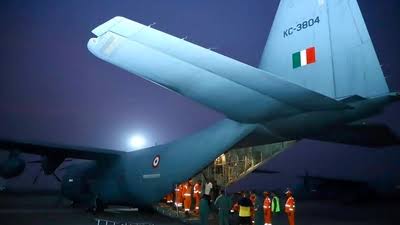
Less than 12 hours after the deadly flash floods hit Nepal on August 26, an Indian Air Force C-130J aircraft took off carrying 10 tonnes of humanitarian and disaster-relief supplies. The first consignment reached Kathmandu later that night.
The rapid response has reinforced India’s growing reputation as a regional “first responder” during major humanitarian emergencies.
India’s relief airlift gathers pace
India’s initial shipment was followed by additional consignments containing essential supplies, including medicines and food packets.
By Thursday, the total quantity of relief material delivered by air had reached 47.5 tonnes. By Friday afternoon, India had sent a total of 62 tonnes of assistance to Nepal.
The speed of the response stood out as several other countries and international organisations were still arranging their assistance.
Prime Minister Narendra Modi spoke with Nepal Prime Minister Balendra Shah on Wednesday, expressing condolences over the loss of life and assuring him that India was prepared to provide all possible humanitarian assistance.
Modi also said Indian teams were coordinating with Nepalese authorities on rescue and relief efforts.
Foreign Minister S Jaishankar subsequently announced the dispatch of the first 10-tonne consignment, saying that India stood with Nepal and its people.
Global support pours in
India is not the only country responding to the disaster.
China has coordinated emergency supplies and financial assistance, while South Korea, the United Kingdom, the European Union and the United States have also offered support.
The US has committed $500,000 along with a disaster-response adviser, while the UK has pledged £5 million and emergency responders.
International organisations, including the United Nations, World Health Organisation and World Bank, have also indicated support for Nepal’s recovery efforts.
The World Bank has indicated that it could provide emergency assistance of up to 25 billion Nepalese rupees, equivalent to about $163.55 million.
Against this backdrop, India’s rapid physical delivery of relief has given New Delhi a prominent role in the immediate response.
What triggered the Nepal disaster?
The disaster struck the Nepal-Tibet border region on August 26.
Initial assessments indicate that a massive glacial collapse may have triggered a powerful torrent of ice, rock, mud and water through mountain river systems.
The resulting destruction affected villages, roads and bridges, leaving communities cut off and intensifying the humanitarian crisis.
Satellite imagery and geological assessments have provided further clues about the sequence of events, although scientists are continuing to examine the precise causes and circumstances surrounding the disaster.
Death toll crosses 470
The scale of the devastation has been enormous.
By Friday afternoon, 469 people had died in Nepal, while three deaths were reported in Tibet, taking the combined death toll to 472.
Nearly 1,000 people were reported missing in Nepal, while 558 remained unaccounted for in Tibet.
The figures are expected to change as rescue teams reach more affected areas and authorities continue search operations.
India’s expanding disaster-response role
India’s response to Nepal follows a broader pattern of New Delhi stepping in quickly during major humanitarian crises.
In recent years, India has provided assistance during disasters and emergencies in several countries, including Türkiye and Syria following the 2023 earthquakes, Myanmar after the 2024 disaster, Sri Lanka after the 2025 cyclone and Venezuela following the 2026 earthquake.
The approach reflects India’s growing emphasis on humanitarian assistance and disaster relief as part of its regional and international engagement.
For Nepal, however, the immediate priority remains rescuing those still missing, reaching isolated communities and delivering essential supplies.
As the Himalayan nation confronts the aftermath of one of its deadliest recent disasters, India’s rapid airlift has placed New Delhi at the forefront of the international relief efforts.