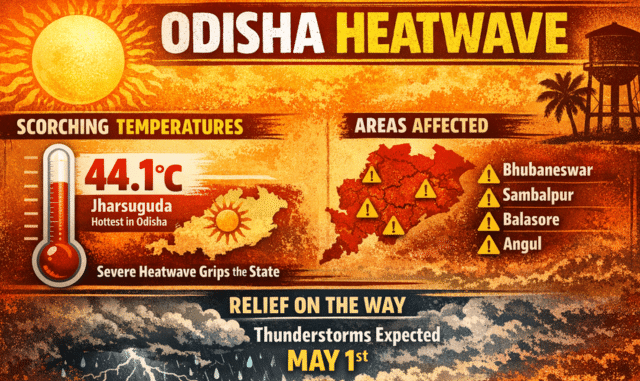
Odisha is currently baking under a ferocious heatwave, with temperatures soaring past the 44-degree mark in two western districts and no immediate relief in sight.
In the last 24 hours, Jharsuguda recorded a scorching 44.1°C, reclaiming the title of the state’s hottest city, while Titlagarh followed closely at 44°C. Balangir sizzled at 43.5°C and Nuapada at 43°C. As many as 13 other towns reported maximum temperatures between 40°C and 43°C, turning daily life into an endurance test for millions.
The Regional Meteorological Centre in Bhubaneswar has painted a clear picture for the coming days. Director Manorama Mohanty confirmed that the next two days will see little change in weather conditions. Western Odisha will remain mostly dry, allowing day temperatures to climb further, while the coastal belt will continue to suffer from oppressive humidity that makes the heat feel even more punishing.
However, good news is on the horizon. From April 27 onwards, the state is expected to witness a significant 2–4°C drop in day temperatures, bringing much-needed relief from the suffocating “gulguli” (humid heat) along the coast.
But the respite will come with its own drama — Kalbaisakhi, the classic pre-monsoon thunderstorms accompanied by strong winds, lightning, and rain.
The IMD has already issued alerts for several southern districts (Ganjam, Gajapati, Rayagada, Koraput, and Malkangiri) for thunderstorm activity on Sunday. Heat-and-humidity warnings remain in force for Balasore, Bhadrak, Jajpur, Kendrapara, Cuttack, Jagatsinghpur, Puri, Khordha, Nayagarh, Ganjam, Gajapati, Jharsuguda, Balangir, Sambalpur, and Angul.
The warning intensifies as we approach Labour Day on May 1. The capital city of Bhubaneswar and as many as 20 districts have been placed under a **Yellow Alert** for thunderstorms, lightning, thunder, and gusty winds. The sky is likely to remain partly cloudy, with maximum temperatures hovering around 39°C.
In a separate advisory, the rough sea condition forecast has prompted authorities to strictly prohibit fishermen from venturing into the sea along the northern Odisha coast from April 26 to 29.
With schools, offices, and daily-wage workers already struggling under the extreme heat, the approaching Kalbaisakhi spells offer a double-edged sword — welcome rain and cooler air, but also the risk of sudden squalls, power outages, and lightning hazards.
Residents are advised to stay hydrated, avoid direct sun exposure during peak afternoon hours, and keep an eye on official weather updates. For now, Odisha continues to burn — but the skies are finally preparing to strike back with a dramatic thunderstorm show.