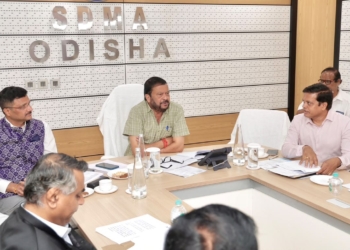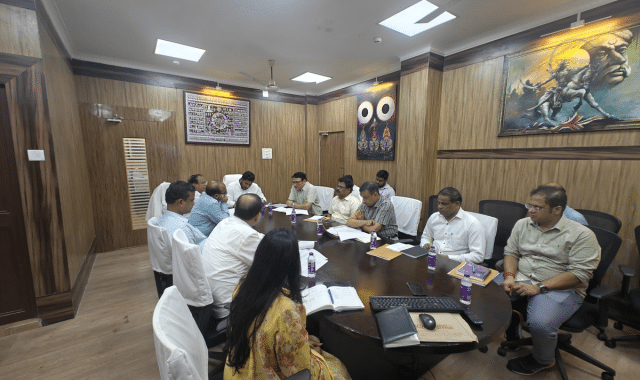
The first meeting of the State-Level Project Management Committee for the implementation of the Baraputra Aitihya Gram Yojana was held today. The meeting was chaired by Suryabanshi Suraj, the Minister of Odia Language, Literature, and Culture, at the Culture Department’s conference hall.
During the meeting, the Minister discussed the effective implementation of the scheme with district collectors from various regions via virtual mode.
Under the Baraputra Aitihya Gram Yojana, the ancestral homes of prominent personalities (referred to as Baraputras) will be transformed into museums. Additionally, statues of these personalities will be installed, and facilities such as interpretation centres, libraries, conference halls, and open-air theatres will be created, along with other supportive infrastructure.
To promote local livelihoods, sales centres for popular local cuisine, handicrafts, and handloom products will also be established. Various seminars, discussions, cultural programs, and events highlighting the lives and contributions of these eminent figures will be organised to promote and share their values and ideals.
In the first phase of the scheme, 25 distinguished personalities have been identified. An estimated budget of up to Rs 15 crores will be allocated for the development of each birthplace village, totalling a maximum expenditure of Rs 345 crores for the development of these 25 villages in the initial phase.
The personalities included in the first phase are: Shaheed Laxman Naik (Koraput), Acharya Harihar Das and Pandit Krupasindhu Mishra (Puri), Jayee Rajguru and Buxi Jagabandhu (Puri District), Pandit Nilakantha Das (Satyabadi), Laxmi Indira Panda (Koraput), Shaheed Rendo Majhi (Kalahandi), Maa Ramadevi and Karmaveer Gourishankar (Cuttack), Fakir Mohan Senapati (Balasore), Chakra Bisoi and Ramchandra Mardaraj Deo (Ganjam), Shaheed Baji Rout (Dhenkanal), Krushna Chandra Gajapati (Gajapati), Ramchandra Bhanjdeo and Pandit Raghunath Murmu (Mayurbhanj), Godabarish Mishra (Khordha), Veer Surendra Sai (Sambalpur), Gangadhar Meher and Shaheed Madho Singh (Bargarh), Laxmikanta Mahapatra and Dr. Harekrushna Mahatab (Bhadrak), Biplabi Dharanidhar Bhuyan (Keonjhar), and Shaheed Dharam Singh Majhi Mandhata (Balangir).
The Minister directed district collectors to identify 2–3 acres of land in these villages or in nearby areas and to inform the Culture Department at the earliest opportunity. He emphasised the importance of considering the opinions of family members, relatives, and local residents in the development of the villages and related activities.
District collectors have been instructed to ensure the proper management and maintenance of facilities such as museums, interpretation centres, and libraries, as well as the promotion of local art and culture and the involvement of local communities.
The Minister also highlighted that the villages included in the scheme should be developed into tourist destinations, creating new livelihood opportunities for local residents through the promotion and sale of handicrafts and other traditional products. He directed officials from various departments to ensure coordination and to expedite the scheme’s implementation.
During his remarks, Minister Suryabanshi Suraj stated, “The Baraputra Aitihya Gram Yojana will significantly contribute to preserving and promoting the values and ideals of our great personalities. It will help the younger generation learn about their sacrifices and contributions and inspire them to embrace their ideals. The scheme will also promote our rich artistic and cultural traditions more broadly.”
The meeting was attended by Dr. Bijay Ketan Upadhyay, Secretary of the Odia Language, Literature and Culture Department; Shri Dipankar Mahapatra, Director of the Tourism Department; Shri Deba Prasad Dash, Special Secretary of the Culture Department; and senior officials from various departments, including Works, Panchayati Raj and Drinking Water, Planning and Convergence, Handlooms, Textiles and Handicrafts, and Odisha State Archaeology.