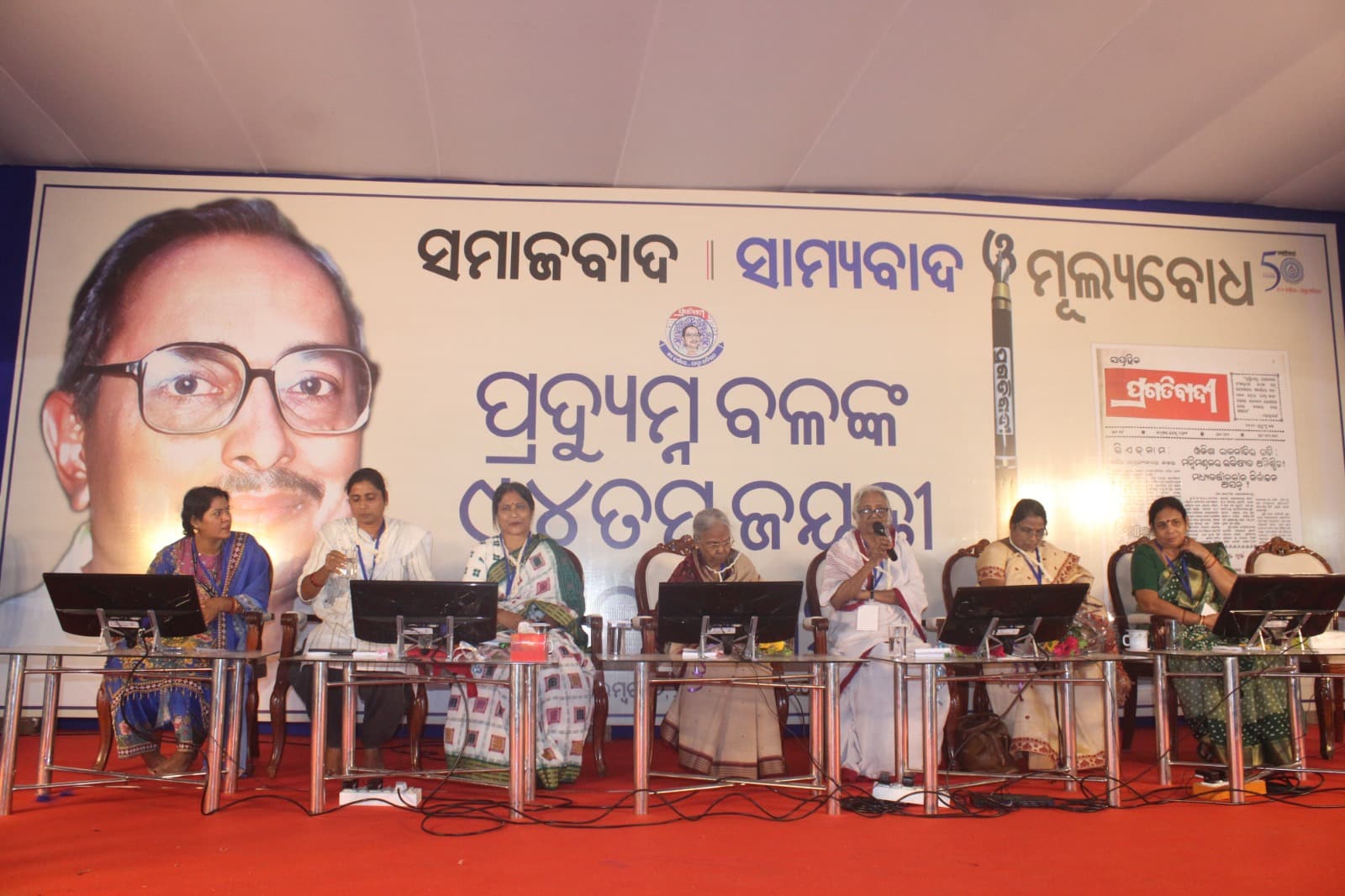
In a thought-provoking discussion organised by leading Odia daily, Pragativadi as part of the 94th state-level birth anniversary celebrations of Pradyumna Bal, speakers underlined that real social progress depends on women’s knowledge, freedom and dignity—not on the dictates of a patriarchal order.
The session, held under the chairmanship of Krishna Mohanty, president of Utkal Gandhi Smaraki Nidhi, carried the theme “Who determines the place of women in our society?” Padma Shri Shyamamani Devi was the chief guest, Dr. Basanti Mohanty the main speaker, Mayor Sulochana Das a distinguished guest, and AISF Odisha president Sanghamitra Jena a special speaker.
Sanghamitra Jena opened with a sharp critique of everyday controls still imposed on women. “Today’s women know very well who is controlling their lives and how,” she said. “What they eat, what they wear, how they keep their hair, how often they visit a beauty parlour, whether they marry or have children—patriarchal society still tries to decide all of this.” She described certain self-appointed “owners” of society as attempting to suppress women’s very existence and praised Pragativadi for bringing such a sensitive issue into public debate, calling its journalists “soldiers of the pen.” Quoting the poet Rama Shankar ‘Bidrohi’, she declared: “The first woman burnt in this world must have been my mother, and the last one will be my daughter. But my fight is that I will never allow this to happen.”
Padma Shri Shyamamani Devi shared her own painful journey as a classical musician. She recalled how, after a newspaper reported one of her performances, she was forbidden even to touch the Radha-Krishna idols in her own courtyard. “Society repeatedly insulted and humiliated me while I pursued music,” she said. Yet her devotion to art carried her to the top. Stressing that men and women are complementary, not rivals, she insisted women must receive the same freedom men enjoy and called for a change in social mindset.
Dr. Basanti Mohanty argued that women’s knowledge and independence are the true measures of societal progress. From birth to death, she noted, life is placed in the hands of goddesses—Sasthi at birth, Nidra Devi for sleep, Saraswati for learning, and the village deity at marriage. “At every critical turn, feminine power is invoked first,” she said. She condemned the old patriarchal notion that knowledge adorns men while ignorance is a woman’s ornament, calling it a deeply discriminatory idea that must be discarded. “Every woman carries a masculine aspect and every man a feminine one,” she observed, urging society to honour feminist thought and recognise women’s autonomy.
Mayor Sulochana Das struck a note of complementarity rather than confrontation. “God created women and men differently; they are not rivals but complementary to each other,” she said. “Some qualities are extra in women, some in men. But when it comes to social status, everyone must be given respect.” She called for women to live freely in the home, society and workplace, and stressed the urgent need for every woman to become educated and economically self-reliant so she can become a real agent of peace and thoughtful progress.
The programme also saw the unveiling of the Pranam Pradyumna music logo, with lyrics by Kabitilak Artatrana Shatapathy, music direction by Kartik Kumar and vocals by Prakasini Sahu.
Pragativadi Chairperson Saswati Bal offered words of encouragement, while journalist Banita Sahu introduced the guests.
The discussion left a clear message: women’s place in society should no longer be decided by self-appointed guardians or outdated texts, but by their own knowledge, choices and equal dignity.