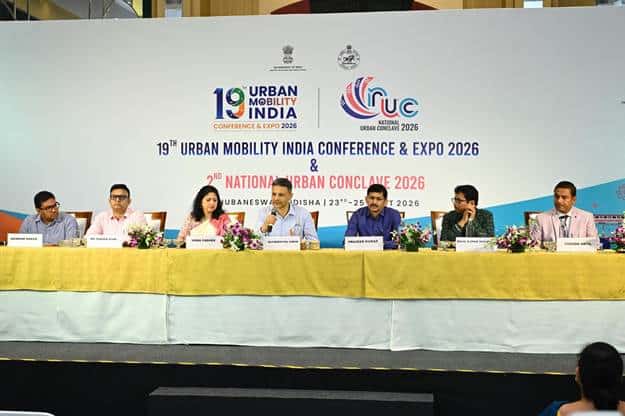
Bhubaneswar is preparing to host one of the most consequential gatherings of urban policymakers, technologists, and practitioners in recent years.
Beginning tomorrow, the Ministry of Housing and Urban Affairs (MoHUA), with the active support of the Government of Odisha, will convene the 19th Urban Mobility India (UMI) Conference and Exhibition followed immediately by the second National Urban Conclave. Together, the two events—running from 23 to 25 October 2026 at Hotel Mayfair Sanctuary—will bring roughly 1,500 delegates, national and international speakers, metro rail executives, transport undertaking chiefs, researchers, and private-sector innovators under one roof to examine how Indian cities can become more accessible, efficient, and liveable.
The timing is deliberate. India’s cities are absorbing the bulk of the country’s population growth, economic expansion, and digital transformation. At the same time, they continue to struggle with fragmented governance, inadequate last-mile connectivity, water and waste inefficiencies, housing shortages, and streets that remain hostile to pedestrians. The dual conferences aim to move the conversation from infrastructure creation to systemic reform—rethinking institutions, delivery mechanisms, regulatory frameworks, and the everyday experience of urban life.
Urban Mobility India 2026: Accessibility and Liveability in the Digital Age
The 19th edition of the Urban Mobility India Conference opens on 23 October under the theme “Urban Accessibility and Liveability in Digital Age.” Organised by MoHUA through the Institute of Urban Transport (India), the two-day event continues the tradition established under the National Urban Transport Policy of 2006, which emphasised capacity building and equitable, sustainable mobility systems.
Joint Secretary Shri Praveer Kumar, briefing the media at the curtain-raiser press conference, outlined the conference’s focus on sustainable and low-carbon public transport, seamless integration across modes, first- and last-mile connectivity, and the growing role of technology. Discussions will examine Mobility as a Service (MaaS) platforms and real-time GPS-based solutions that can deliver seamless journeys rather than disconnected bus, metro, and shared-mobility segments. The underlying premise is that digital tools, properly deployed, can convert existing infrastructure into more responsive, user-centred systems while lowering carbon intensity.
The conference will be inaugurated by Union Minister of State for Housing and Urban Affairs Shri Tokhan Sahu in the presence of Odisha’s Minister for Housing and Urban Development, Dr. Krushna Chandra Mahapatra, and other dignitaries. An accompanying exhibition will showcase best practices from India and abroad, along with the latest technologies and services in urban transport. Twenty-eight exhibitors from the Government of Odisha, metro rail companies, and public and private entities will participate. The exhibition is scheduled to run across both days of the conference.
A distinctive feature is the Research Symposium, structured in four sessions to give young research scholars and PhD students a platform. Forty-six papers were selected by a peer group; twenty will be presented orally and twenty-six as posters. A jury will select the three best papers, each of which will receive a cash award of ₹25,000 and certificates. The initiative reflects an effort to link academic work more closely with policy and practice.
National Urban Conclave 2026: Rethinking Systems, Solutions and Delivery
Immediately following the mobility conference, the second National Urban Conclave opens on 24 October and continues through 25 October. Instituted as an annual platform, the Conclave’s inaugural edition was held in New Delhi in November 2025. This year’s theme—“Urban Rising – Rethinking Urban Systems, Solutions and Delivery”—signals a shift toward institutional and implementation questions rather than purely project-level interventions.
Additional Secretary Shri Satinder Pal Singh explained that the Conclave is organised by MoHUA with support from the Government of Odisha, principal sponsorship from HUDCO and NBCC, and the National Institute of Urban Affairs (NIUA) as knowledge partner. It will be inaugurated by Shri Tokhan Sahu in the presence of Odisha Chief Minister Shri Mohan Charan Majhi. Shri Anurag Jain, CEO of NITI Aayog, and Shri Rajiv Gauba, Member of NITI Aayog, are expected to participate as chief guests. A meeting of Urban Development Ministers from states and Union Territories is also scheduled, providing an opportunity to review progress on issues raised in earlier national and regional consultations and to identify priorities for coordinated action.
The Conclave is organised around seven thematic sessions that address interlocking dimensions of urban performance.
The “Right to Walk” session confronts a basic but persistently neglected aspect of city life: the quality and continuity of pedestrian infrastructure. Continuous footpaths, safer school zones, better crossings, and improved last-mile links are framed as essential rather than optional elements of urban design. In many Indian cities, the absence of safe walking environments forces residents—especially children, the elderly, and those who cannot afford private vehicles—into riskier choices and reduces the viability of public transport.
Under “Water, Waste and Resource Efficiency,” the emphasis moves beyond the construction of treatment plants and distribution networks toward operational performance. Reducing non-revenue water, promoting reuse of treated water, and recovering value from waste streams are presented as practical steps that can stretch existing assets and lower environmental loads.
“Affordable Housing” will examine the persistent shortfall in rental accommodation, the complexity of regulatory approvals, limited access to land and finance, and the slow adoption of climate-resilient, lower-cost construction technologies. The session is expected to explore how policy and market instruments can be recalibrated to expand supply without relying solely on ownership models.
“Integrated Urban Development and Infrastructure Delivery” will look at coordination failures among agencies, the potential of GIS-based planning, and the benefits of integrated utility corridors. Better sequencing and shared data systems are seen as ways to reduce duplication and accelerate execution.
“New Paradigms for Urban Service Delivery” asks how municipalities can improve outcomes through clearer institutional roles, stronger own-source revenues, procurement reforms, technical capacity, and structured partnerships with the private sector. The underlying recognition is that physical assets alone do not guarantee reliable services if the organisations responsible for operating them lack resources or accountability.
“Model Building Bye-Laws” will consider updates to the regulatory framework that could simplify approvals, strengthen safety and accessibility standards, and accommodate climate resilience and new construction technologies. The goal is to reduce delays and ambiguities that currently slow housing and commercial development while maintaining basic protections.
Finally, “Model Municipal Law” will examine legislative changes needed to strengthen municipal autonomy, clarify the respective powers of elected representatives and executive authorities, and improve institutional capacity and accountability. Governance reform is positioned as a prerequisite for sustained improvements in service delivery.
Collectively, these sessions aim to generate practical recommendations that can feed into state and national policy processes rather than remaining at the level of general principles.
Odisha’s Host Role and Parallel Initiatives
The decision to locate both events in Bhubaneswar reflects the state government’s growing engagement with national urban debates. Additional Chief Secretary Smt. Usha Padhee, speaking at the press conference, underscored Odisha’s commitment to sustainable urban development, improved mobility, and efficient service delivery. Hosting the conferences is presented as an opportunity both to showcase state initiatives and to absorb lessons from other parts of the country.
Several concrete launches and displays are planned during the events. The launch of PM e-Bus Sewa in Odisha is scheduled, advancing the shift toward cleaner public transport. The state will also release the ANKUR Handbook, Odisha Town Planning Handbooks, and a Policy on Government and Privately Owned Public Spaces, materials intended to support capacity building, planned growth, and more accessible public spaces.
A dedicated CRUT (Capital Region Urban Transport) pavilion will illustrate Odisha’s public transport trajectory through the Ama Bus system, electric mobility efforts, feeder services, women’s participation, and technology features aimed at passenger convenience and safety. Renowned sand artist Sudarsan Pattnaik will create a special installation linking Odisha’s cultural heritage with themes of sustainable and inclusive mobility, emphasising pedestrians, cyclists, and accessible streets.
Bhubaneswar Municipal Corporation is undertaking city-wide cleanliness, sanitation, beautification, and public-space improvements ahead of the arrival of delegates. Exposure visits will highlight waste processing and resource recovery facilities, shelters and rehabilitation centres, inclusive neighbourhood development, urban greenery, and citizen services. The Bhubaneswar Development Authority is supporting the events through exhibition displays and visits that showcase planned urban development, housing schemes, town planning initiatives, public transport infrastructure, parks, and rejuvenated public spaces.
Delegates will also have opportunities to experience the city on foot and by bicycle through special Ekamra Walks and a cycle trail, reinforcing the non-motorised mobility themes under discussion. Odisha will share its experience in bus modernisation, regional mobility planning, and urban service delivery, connecting national deliberations with local implementation.
Additional cultural and livelihood elements include participation by Mission Shakti to display products of women’s self-help groups, Utkalika to present Odisha’s handicraft traditions, Boyanika to highlight handloom heritage, and Koraput Coffee to introduce the region’s distinctive coffee produce and associated livelihoods.
Broader Context and Expected Outcomes
The two events sit within a longer trajectory of Indian urban policy. The National Urban Transport Policy provided an early framework for rebalancing investment away from private vehicles toward public and non-motorised modes. Subsequent programmes have expanded metro systems, bus fleets, and smart-city infrastructure, yet many cities still face uneven service quality, institutional fragmentation, and streets that do not prioritise pedestrians or cyclists. The current conferences attempt to address these residual gaps by focusing on integration, digital tools, regulatory simplification, and municipal capacity.
Digital technologies receive particular attention in the UMI theme. Real-time information systems, integrated ticketing, and MaaS platforms can reduce the friction that currently discourages public transport use. At the same time, the Conclave’s emphasis on institutional and legal reform acknowledges that technology alone cannot compensate for weak coordination or unclear lines of accountability. The pairing of the two events therefore offers a useful juxtaposition: mobility specialists can examine operational and technological solutions, while urban administrators and legislators can consider the enabling frameworks those solutions require.
The presence of NITI Aayog leadership, a ministers’ meeting, and both central and state elected representatives is intended to create pathways from discussion to follow-up. Whether those pathways materialise will depend on the specificity of recommendations that emerge and the willingness of participating governments to translate them into budgeted programmes and regulatory changes.
For Bhubaneswar itself, the week represents both an organisational test and a visibility opportunity. The city’s preparations—ranging from sanitation drives to heritage walks and a purpose-built sand installation—signal an attempt to present a coherent narrative of cultural continuity alongside modern mobility and service improvements. How successfully that narrative is conveyed to delegates, and how much of the subsequent national conversation reflects Odisha’s local experience, will be one measure of the events’ impact.
As the conferences open, the central question remains practical rather than rhetorical: can Indian cities move from piecemeal infrastructure projects to more coherent systems of planning, regulation, financing, and delivery that improve everyday accessibility and liveability for the majority of residents? The discussions in Bhubaneswar over the next three days are designed to supply part of the answer. The real test, as participants themselves acknowledge, will come in the months and years of implementation that follow.