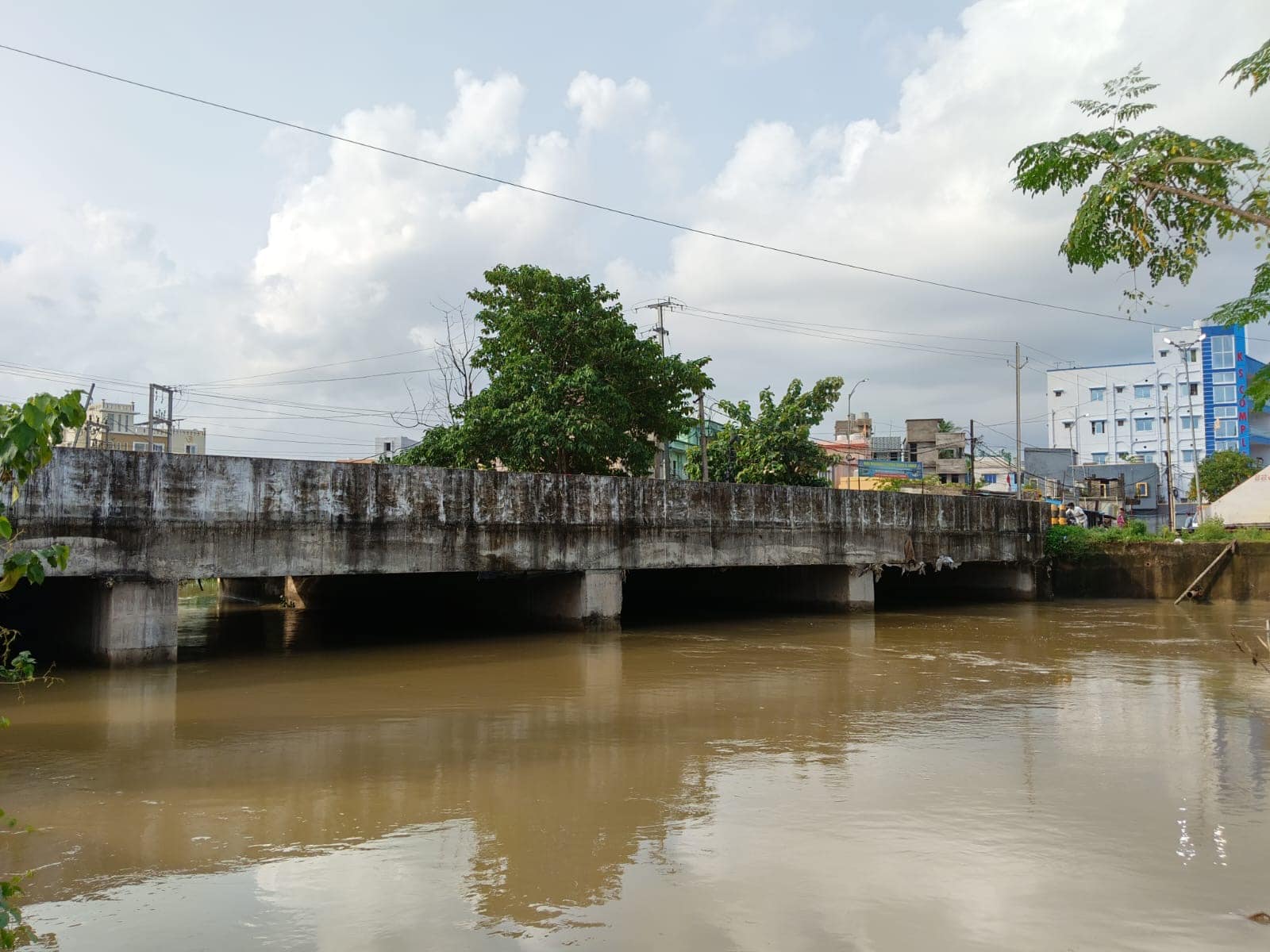
The impact of flooding continued for the second consecutive day in the state capital Bhubaneswar on Friday, with water still not receding from the lower reaches of the Gangua. As a result, floodwaters from the upper stretches of the Gangua have been surging onto roads, particularly affecting residents living in the Gangua basin areas of Mancheswar, Chatei Sihani, Palasuni and Pandara.
Mancheswar rural pockets, especially Satya Bihar and Palasuni, have been among the worst-hit. Floodwaters from the swollen Gangua are flowing on roads in these localities. Near the Ward No. 5 office road, water has been flowing for two days, causing widespread hardship for residents. Water has also accumulated in the main drains, leaving roads waterlogged and disrupting daily movement. Several houses remain submerged and traffic has been severely affected.
Bhubaneswar’s rainwater drainage depends almost entirely on the Gangua. Water flows from internal drains into the main drains and finally into the Gangua before emptying into the Daya river. This year, water is not draining from the lower end while water from the main drains is flowing directly into the Gangua, leading to the current urban flooding situation.
BDA Vice-Chairman IAS Chanchal Rana said the development of the Gangua has reached the Detailed Project Report (DPR) stage after discussions involving Bhubaneswar MP Aparajita Sarangi, MLAs and departmental officials. Work on the Gangua drain will begin after Cabinet approval, he stated.
Rana explained that when the city’s main drains were linked to the Gangua, the volume of water requiring drainage was much lower. With less concretisation earlier, a large portion of even record rainfall used to percolate into the ground. Increasing concretisation has reduced groundwater recharge, so most rainwater now flows through the main drains into the Gangua and then the Daya. The failure of water to recede from the lower reaches this time has delayed drainage through the Gangua.
Like other rivers, the Gangua has a limited water-holding capacity. Excess water beyond this capacity has created the flood situation, the BDA Vice-Chairman said. He noted that the Gangua’s width should be a minimum of 90 metres according to the city’s capacity, but it currently stands at only about one-third of that.
The State Water Resources Department has taken up the development of the Gangua. A plan has been prepared for the development of 33 km of the Gangua river at an estimated cost of over ₹800 crore. After conducting a preliminary survey, the Bhubaneswar Development Authority (BDA) has submitted a master plan to the Water Resources Department, incorporating a report from IIT Roorkee. People living on private land and in low-lying areas of the Gangua basin have been identified. The government aims to rehabilitate them at the earliest and proceed with the development of the Gangua, Rana added.