The landfall process of Very Severe Cyclonic Storm Arnab continued along the Andhra Pradesh coast early Wednesday, with the India Meteorological Department (IMD) stating that the system remained nearly stationary close to the shoreline, prolonging the crossing.
According to the IMD, the landfall process began around 1:20 a.m. IST on October 28. Arnab was expected to cross between Bapatla and Visakhapatnam, close to the south of Yanam (Puducherry enclave), as a very severe cyclonic storm with maximum sustained winds of 125–135 kmph, gusting up to 150 kmph. The northern spiral band had already moved further inland, and the process was forecast to continue for another few hours due to the system’s slow movement.
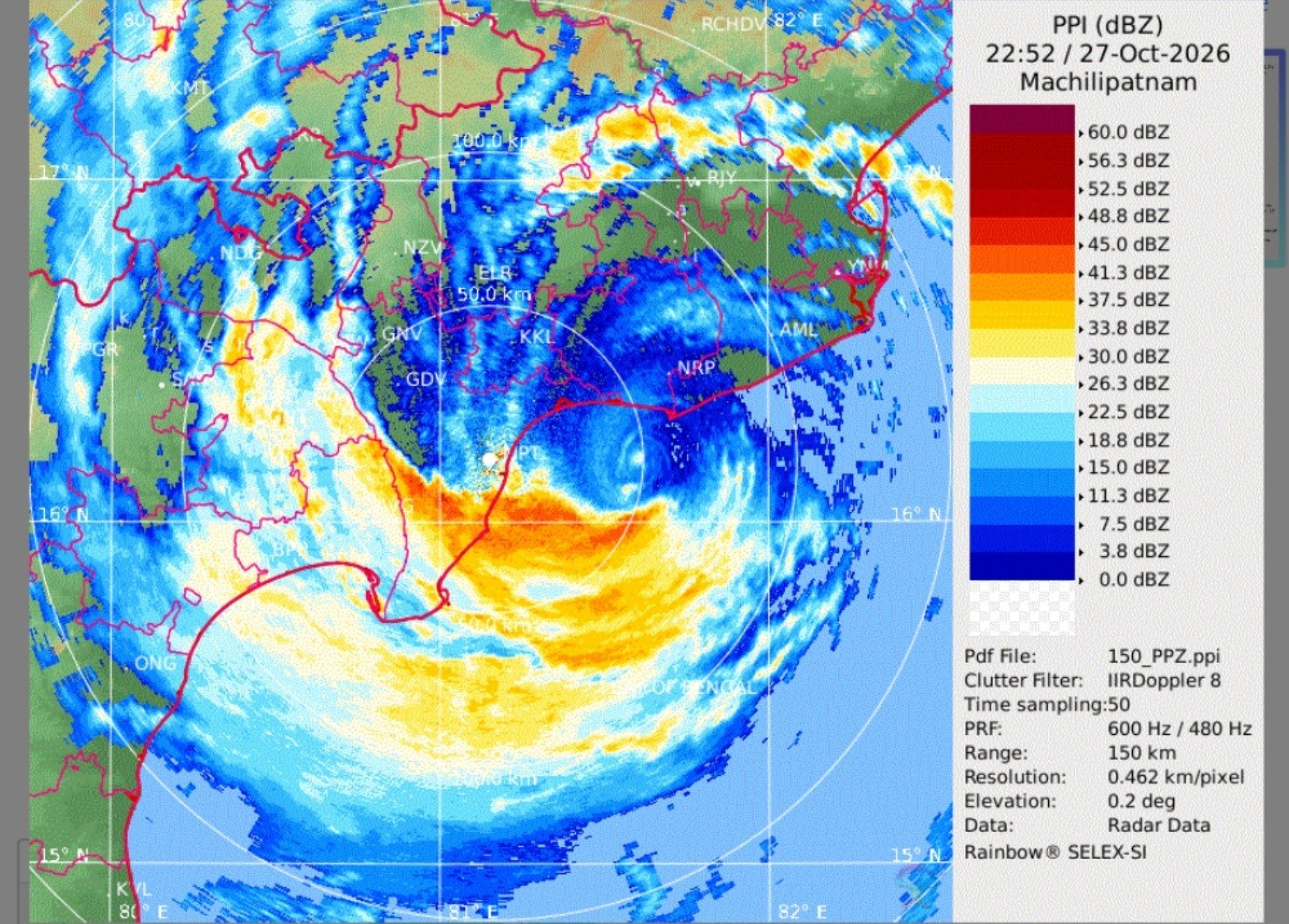
Earlier updates placed the storm’s centre roughly 30 km east of Narsapur, 45 km south-southwest of Yanam and 70 km south-southwest of Kakinada. Radar imagery from Machilipatnam showed intense precipitation bands interacting with the coast.
Northern coastal districts, including Visakhapatnam, Anakapalli, Vizianagaram, Srikakulam, Kakinada and Dr B.R. Ambedkar Konaseema, experienced heavy to extremely heavy rainfall and strong winds. One death was reported in Visakhapatnam after a 65-year-old man came in contact with snapped live electrical wires. Over 84,000 people were evacuated to 290 cyclone shelters, and authorities remained on high alert.
Transport was severely disrupted, with dozens of trains and multiple flights cancelled or delayed. Storm surge of 1.5–2.5 metres above the astronomical tide was expected to inundate low-lying areas near Kakinada, Yanam and the Godavari river mouth.
The storm is likely to weaken rapidly after moving inland, though heavy rainfall is expected to continue in parts of Andhra Pradesh, Yanam and adjoining regions.