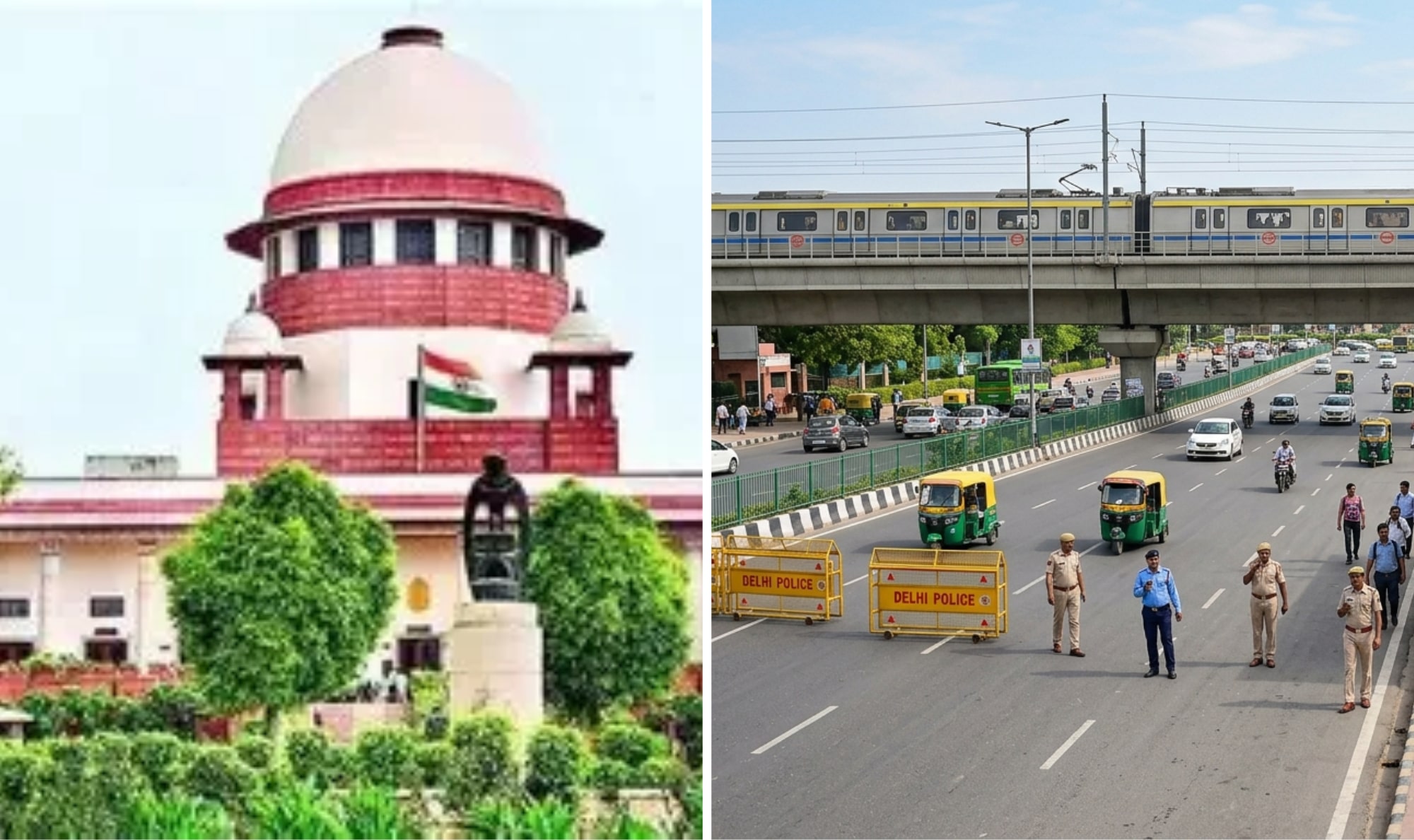
In an extraordinary Sunday special hearing, the Supreme Court directed the Centre and Delhi Police to ensure that the Delhi Metro and train network operate on normal schedules and that internet services remain undisturbed in accordance with the law.
Addressing petitions challenging severe transit restrictions, barricading, and illegal detentions, the apex court underscored that normal public movement must be restored across the national capital.
Strict Directives Against Transit Shutdowns
A two-judge bench comprising Justices Joymalya Bagchi and V. Mohana made it clear that blanket shutdowns of transit services cannot be enforced unless critical law-and-order situations strictly require them under Article 19(2).
“Metro and rail facilities shall function normally, until regulations require to be imposed keeping in mind the disruption to public order,” the bench directed, adding that the principle of proportionality must govern any administrative action.
The directives came following a wave of public frustration triggered by a 25-hour security closure on Saturday, during which 45 major metro stations were shut down, and multiple incoming trains were cancelled due to ongoing demonstrations against Chief Election Commissioner (CEC) Gyanesh Kumar.
Review of Barricades & Protection of Legal Fraternity
In its order, the Supreme Court instructed authorities to forthwith review barricades across the capital and remove them unless explicitly warranted by traffic or law-and-order considerations.
The court also ordered the immediate removal of notice boards citing Section 163 of the Bharatiya Nagarik Suraksha Sanhita (BNSS) near the Supreme Court premises to prevent any hindrance to justice or apprehension among citizens accessing the courts.
Furthermore, the bench emphasised that lawyers must not be stopped or impeded from discharging their professional duties.
Government Assurances and Court’s Mandate
Representing the Union Government, Solicitor General Tushar Mehta informed the bench that internet services had already been restored and entry/exit gates at all metro stations were re-opened.
Recording the government’s assurances, the court demanded a detailed affidavit, including a mapping report outlining which metro stations were closed during the peak of Saturday’s restrictions. The court reiterated that while peaceful assembly must be respected, no illegal detentions should take place.
The Supreme Court will hear the matter again on Tuesday to review compliance and further affidavits.