
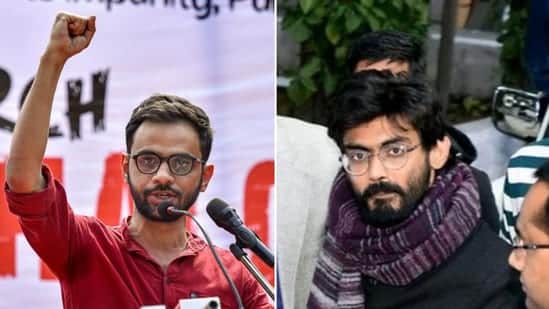
The Supreme Court of India has denied bail to Umar Khalid and Sharjeel Imam, both accused in the Delhi riots case, emphasizing their “qualitatively different” role compared to other accused.
On January 5, 2026, the apex court upheld the Delhi Police’s stance that the two individuals stood on a significantly different footing from other co-accused in the case, making their bail applications unsustainable at this stage of the proceedings.
Court’s Observations on Bail Denial
The Supreme Court clarified that not all accused persons are treated equally under the law when it comes to granting bail. The Court noted that Umar Khalid and Sharjeel Imam’s involvement in the Delhi riots case required an individualized approach to their bail applications, as their roles, as per the prosecution’s case, were of a “qualitatively different” nature.
The Court emphasized that while considering bail, equality could not be applied “mechanically” as each case needs to be evaluated based on the hierarchy of participation. The case against both Khalid and Imam contained prima facie allegations that were deemed strong enough to justify their continued detention.
The Court’s Rationale
In its ruling, the Supreme Court pointed to Article 21 of the Indian Constitution, which protects an individual’s right to life and liberty. However, the Court also acknowledged that prolonged pre-trial detention must be justified by the state, which has to provide adequate grounds for keeping the accused in custody before trial. In this case, the Court was satisfied that the evidence presented in the prosecution’s case met the statutory threshold for denying bail under the Unlawful Activities (Prevention) Act (UAPA).
The UAPA, being a special statute, lays down specific conditions for bail during pre-trial detention. The Court noted that delay in the trial process cannot automatically be treated as a valid reason for granting bail, and the statutory safeguards under Section 43D(5) of the UAPA were still applicable in this context.
Legal Significance of the Ruling
Section 43D(5) of the UAPA mandates a special judicial scrutiny for bail in cases involving terrorism-related charges, ensuring that no one is granted bail unless there is a clear lack of prima facie evidence. This provision has been a point of debate due to its stringent nature, but the Court reaffirmed that while it imposes a heavy threshold for granting bail, it does not entirely prevent judicial review.
The ruling underscores that while the law provides statutory safeguards, the deprivation of liberty cannot be arbitrary. The Court’s approach indicates that the accused’s rights to a fair trial are balanced against the state’s need to ensure public order and justice, particularly when national security concerns are involved.
Impact on the Delhi Riots Case
Umar Khalid and Sharjeel Imam are among several accused involved in the controversial Delhi riots case, which has attracted national and international attention. The case revolves around violent protests that occurred in Delhi in February 2020, with allegations of larger conspiracy and instigation. Both Khalid and Imam have been accused of instigating the violence through inflammatory speeches and actions.
The Supreme Court’s refusal to grant bail to Khalid and Imam signals a tough stance on cases under the UAPA, especially those involving national security concerns. It is likely to have significant ramifications for other similar cases, setting a precedent for how bail applications are handled under the Act.