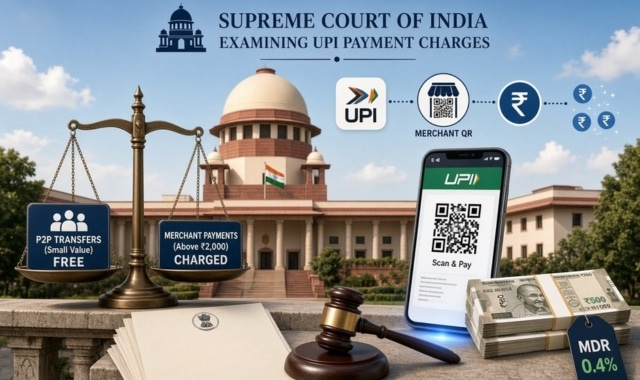
The Supreme Court is set to examine the legality of the Centre’s decision to roll back nearly six years of fully free Unified Payments Interface (UPI) transactions.
A bench comprising Chief Justice of India Surya Kant, Justice Joymalya Bagchi, and Justice V Mohana will hear a public interest litigation (PIL) challenging the imposition of a Merchant Discount Rate (MDR) on specified person-to-merchant (P2M) transactions exceeding Rs 2,000.
The New Framework at a Glance
Under the framework notified by the government, a 0.4 per cent MDR applies to general merchant payments crossing the Rs 2,000 threshold, capped at Rs 300 for transactions of Rs 75,000 and above. However, the policy ring-fences everyday person-to-person (P2P) transfers and small-ticket transactions, maintaining zero charges for them. Sector-specific rules have also been introduced:
-
Essential & Thin-Margin Sectors: Railways, telecom, insurance, fuel, and agricultural inputs attract a flat MDR of Rs 5 per transaction above Rs 2,000.
-
Capital Markets: Payments into mutual funds, securities, and transactions via stockbrokers attract a 0.02 per cent MDR, capped at Rs 300.
-
Exemptions: P2P transfers—accounting for 37% of volume and 70% of value—alongside small merchants receiving up to Rs 1 lakh monthly via QR codes, remain fully exempt.
Core Grounds of the Challenge
Filed by advocate Anjan Datta, the PIL challenges the Centre’s September 14 notification and the consequent MDR framework. The petition argues that the levy was introduced without adequate statutory safeguards, public consultation, or transparency.
Crucially, the plea challenges the constitutional validity of the amended Section 10A of the Payment and Settlement Systems Act, 2007, claiming it grants unguided powers to the executive. The petitioner also highlighted a sharp regulatory contrast, noting that RuPay debit cards continue to enjoy zero-charge protection without any monetary ceiling, making the framework arbitrary and discriminatory.
The plea seeks either the complete suspension of the MDR framework on high-value UPI transactions or a comprehensive reconsideration backed by empirical data, impact assessments, and structured protections for micro and small enterprises. With the Reserve Bank of India and the Centre named as respondents, Monday’s hearing will test the legal boundary of digital payment regulations in India.