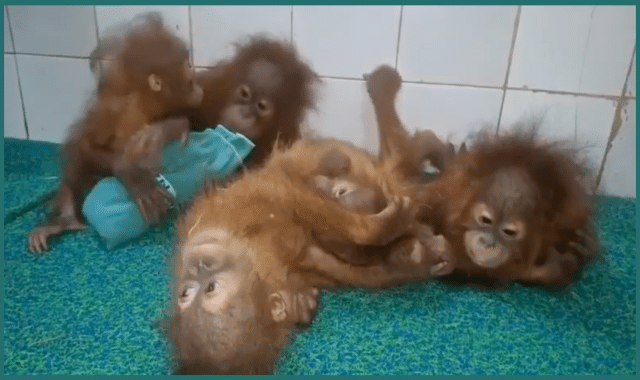
Five infant orangutans who turned up in an Odisha casuarina plantation earlier this month are now holding their own. The latest health bulletin from Nandankanan Zoological Park, describes all five as apparently healthy, with normal appetite, behaviour, activity and faecal consistency.
The infants — three males and two females, estimated to be between six months and a year old — have been in quarantine at the Bhubaneswar zoo since their rescue on 8 September from the Bichitrapur forest area in Baleshwar’s Bhograi block. Orangutans are not native to India; they live only in the rainforests of Borneo and Sumatra and are listed as critically endangered. Their sudden appearance near a highway and the West Bengal border immediately raised suspicions of international wildlife trafficking.
Weights recorded on 22 September show modest gains for some of the smallest animals. Male 1 now weighs 5.6 kg, Male 2 3.6 kg, Male 3 3.1 kg, Female 1 4.29 kg and Female 2 2.24 kg. Thermal-camera readings put their body temperatures between 98.2°F and 98.8°F — within the expected range. Feed acceptance remains normal across the group.
Blood samples were collected from all five for complete blood count examination. Two of the infants, identified as M3 and F2, showed improvement in haemoglobin concentration after earlier tests had flagged anaemia. Male 3 has received a subcutaneous erythropoietin injection to support further recovery. The zoo notes that supportive supplementation and round-the-clock monitoring continue.
Earlier bulletins had recorded fever in one infant and anaemia ranging from mild to severe in three of the five. A technical committee that included veterinarians from Mysore Zoo, Delhi Zoo and the Wildlife Institute of India has guided diet and treatment changes, including gradual increases in milk volume, introduction of steamed vegetables and antiparasitic medication. Soft toys, swings, ladders and ropes have been added to the quarantine rooms to reduce stress and encourage natural movement.
The investigation into how the animals reached coastal Odisha remains active. Odisha Police’s Special Task Force and the Wildlife Crime Control Bureau are examining CCTV footage, a reported black SUV seen in the area the night before the discovery, and possible routes through West Bengal. Indonesian authorities and CITES have been contacted about eventual repatriation once the infants are medically cleared.
For now the focus stays on the five small primates themselves. Sixteen days after they were found clinging to trees far from any rainforest, the latest numbers from Nandankanan suggest they are beginning to recover from the journey that brought them here.