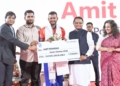
Decades after he stepped away from active politics, Pradyumna Bal’s towering but largely unsung contribution to Odisha’s political landscape finally received overdue recognition on the foundation day of his brainchild, Pragativadi, a leading Odia Daily.
Senior leaders across generations declared that the state’s political history has never truly measured the decisive role played by the man who single-handedly rescued the Congress party in Odisha between 1967 and 1980.
“From the 1960s to the 1980s, Pradyumna Bal was the undisputed kingpin of Odisha politics,” said former Union Minister Srikant Jena, addressing a packed gathering. “When the Congress was leaderless and crumbling, he took charge, reorganised the party from the grassroots and breathed new life into it across the state. He brought waves of young people and students into the fold and rebuilt it brick by brick.”
Jena revealed a little-known chapter that shaped modern Odisha politics. In 1971, Bal was the natural choice for the prestigious Cuttack Lok Sabha seat. Instead, he stepped aside at the request of a young Janaki Ballav Patnaik and personally ensured the latter got the ticket. While Bal contested the Kendrapara seat and lost by a razor-thin margin of just 5,000 votes, Patnaik won Cuttack and went on to become a Union Minister — the launchpad for his long and storied career.
“Without Pradyumna Bal, Janaki Ballav Patnaik’s political journey might never have begun,” Jena asserted.
The tributes poured in thick and fast.
Revenue and Disaster Management Minister Suresh Pujari recalled his own student days when Bal became a mentor and father figure. “Whenever I met Pradyumna Babu, he would first make sure I had eaten and then quietly slip ₹50 into my pocket. For a struggling student leader in those days, that small gesture meant everything,” Pujari said. “He stood like a rock behind every student agitation and every just demand.”
Former Minister Panchanan Kanungo described Bal as the man who gave countless young Odias their first political break. “For boys like us, Pradyumna Bal and Shyamsundar Mahapatra were the real inspiration. He was a master organiser who built the party from the roots up. Today the Congress desperately searches for such an organiser — and cannot find one,” Kanungo lamented.
He credited Bal with creating the *Pragativadi Chhatra Union*, a student body that produced leaders like Lalit Pattajoshi, and then launching the weekly *Pragativadi* newspaper — without any ministerial post or official power. “While every other newspaper in Odisha had a Chief Minister behind it, Pradyumna Bal brought out *Pragativadi* purely on the strength of the people. He always said the paper would run on public support — and it did. It was by the people, for the people and of the people,” Kanungo noted.
Former Minister Amar Prasad Satapathy added another dimension to Bal’s legacy. “In every political transformation Odisha has seen, Pradyumna Bal’s role was decisive. He never compromised his principles, never indulged in sycophancy and never hesitated to take a clear stand. Odisha has rarely seen a politician so fearless and uncompromising.”
The speakers were unanimous on one point: Odisha’s political history has yet to give Pradyumna Bal his rightful place. As Kanungo put it, “A full and honest assessment of Pradyumna Bal and *Pragativadi* would be a priceless addition to the state’s political heritage.”
As the *Pragativadi* foundation day celebration concluded, one message rang loud and clear: the man who built organisations, mentored leaders, launched newspapers and quietly shaped governments may have stayed away from the limelight, but his footprints remain indelible on Odisha’s political soil. The only question left is — when will the state finally acknowledge its debt to Pradyumna Bal?