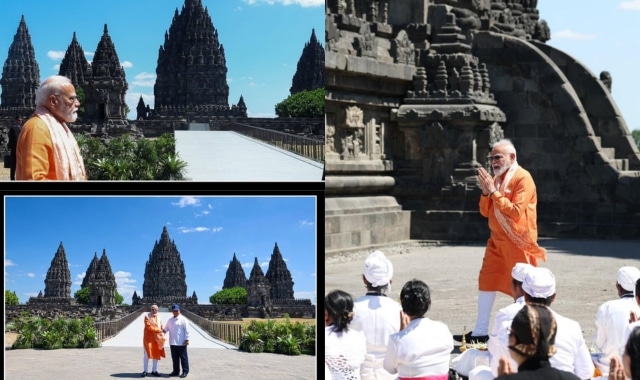
Prime Minister Narendra Modi visited Indonesia’s iconic Prambanan Temple on July 8 with President Prabowo Subianto, offering prayers at the nearly 1,000-year-old Hindu shrine dedicated to the Trimurti—Lord Shiva, Lord Vishnu, and Lord Brahma.
Built in the 9th century, Prambanan stands as Indonesia’s largest Hindu temple complex and one of Southeast Asia’s greatest architectural marvels. Constructed during the reigns of Rakai Pikatan and Rakai Balitung of the Mataram Kingdom, the sprawling complex originally featured 240 temples. The central Shiva temple rises 47 metres high, housing statues of Lord Shiva, Goddess Durga, Lord Ganesha, and the sage Agastya.
Intricate bas-reliefs on the temple walls depict scenes from the Ramayana, making Prambanan one of the world’s most remarkable artistic interpretations of the epic. Between May and October, the temple hosts the famous open-air Ramayana Ballet, performed against its illuminated backdrop.
Prambanan is also steeped in folklore. According to Javanese legend, Prince Bandung Bondowoso attempted to build 1,000 statues in a single night to marry Princess Roro Jonggrang. He completed 999 before dawn, but the princess tricked him into believing morning had arrived. Enraged, he cursed her into becoming the 1,000th statue.
After centuries of abandonment and earthquake damage, Prambanan underwent restoration and was designated a UNESCO World Heritage Site in 1991. During his visit, PM Modi announced India’s assistance in conserving the temple, describing it as a symbol of shared civilisational heritage. Both leaders welcomed an Archaeological Survey of India-supported restoration project using the anastylosis technique, which reconstructs damaged structures with original stones.