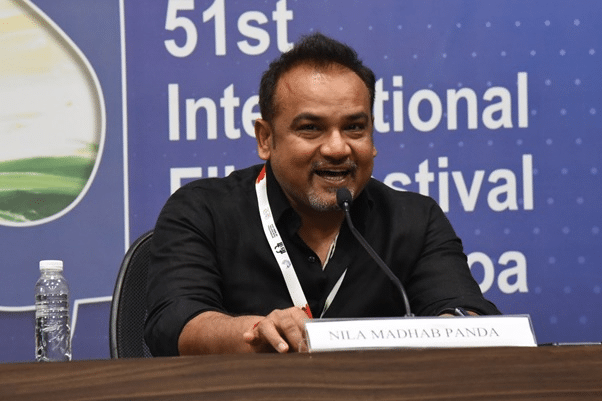
Odisha has a seat at the table that decides what Indian cinema can show on the big screen. Padma Shri filmmaker Nila Madhab Panda has been appointed to the reconstituted Central Board of Film Certification (CBFC), the statutory body that certifies films for public exhibition in India.
The Ministry of Information and Broadcasting today issued the notification to this effect. Acting under Section 3(1) of the Cinematograph Act, 1952, read with Rule 3 of the Cinematograph (Certification) Rules, 2024, the Centre reconstituted the 18-member board with immediate effect. The members will serve for three years or until further orders, whichever is earlier.
Nila Madhab Panda is the only Odia name on the panel. For a state whose cinema often struggles for national visibility, the appointment is being read as recognition of both the filmmaker and the stories he has carried from Odisha to the rest of India.
Born on 18 October 1973 in Dasharajpur village of Sonpur district, Panda grew up far from the film industry. He later studied entrepreneurship at IIM Bangalore and built a career around socially rooted cinema. His films have taken on climate change, water scarcity, sanitation, child rights and rural hardship. *I Am Kalam* won a National Award and dozens of international honours. *Jalpari* was recognised at Cannes. *Kadvi Hawa* earned a National Award special mention. His Odia film *Kalira Atita* won the National Film Award for Best Odia Feature Film. In 2016, he received the Padma Shri.
The new board also includes actors Preity Zinta, Suniel Shetty, Pankaj Tripathi, Prosenjit Chatterjee, Manoj Joshi, Roopali Ganguly, Pallavi Joshi and Nishigandha Wad; filmmakers Priyadarshan and Abhishek Jain; Grammy-winning composer Ricky Kej; producer Supriya Yarlagadda; singer Hansraj Hans; writer Yatindra Mishra; theatre personality Waman Kendre; and Vinod Anupam and Ramesh Patange.
CBFC Chairperson Shashi Shekhar Vempati welcomed the new members after the list was released. The board works under the Ministry of Information and Broadcasting and is responsible for age-based certification of films meant for theatrical release.
For Odisha’s film community, Panda’s presence matters because certification decisions shape how regional films travel, how local stories are framed, and whether filmmakers from smaller industries find a fair hearing in a national process. His own work has often treated Odisha not as a backdrop but as the centre of the story. That experience now sits inside the country’s film certification body.
The reconstitution comes after a long gap. The previous board was last formally reconstituted in 2017, and the CBFC had only recently held a board meeting after years.
Panda’s appointment does not by itself rewrite the map of Indian film certification. It does, however, put an Odia filmmaker with a record of social and environmental cinema on a board that will influence how films from every language industry, including Odia cinema, reach audiences over the next three years.