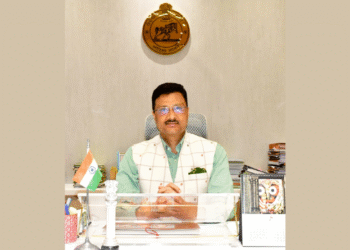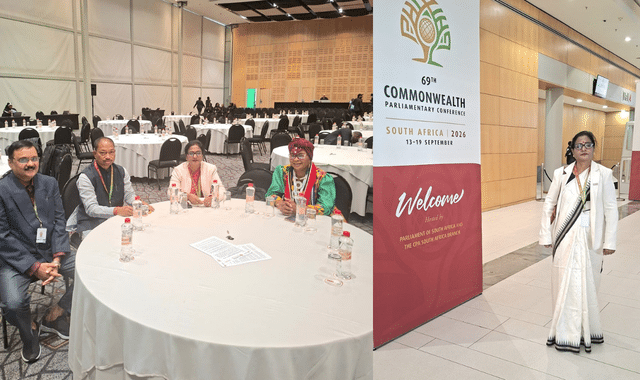
Democracy can change its tools. It cannot change its first duty. That was the message Odisha Legislative Assembly Speaker Surama Padhy carried to Cape Town, where she joined the Commonwealth Parliamentary Association’s flagship gathering and spoke in a session titled “Accessible Parliament: Inclusion of Persons with Disabilities.”
The world order is shifting, she said. Technology is rewriting institutions. Legislatures themselves are being digitised. None of that, she argued, authorises a retreat from equal citizenship. “Democracy must ensure equality for every citizen, and this principle can never be changed.”
She did not begin with statutes. She began with memory. Invoking sage Ashtavakra — the scholar whose body was bent, and whose intellect was not — Padhy said Indian civilisation has long recognised that disability is not the absence of contribution. The same, she added, is true of the Republic. Persons with disabilities have sat in India’s democratic institutions and helped shape national progress. In the 2024 general elections, more than 90 lakh Divyangjan were registered as voters — a figure she used as proof that political belonging is already being claimed at scale.
What remains is to make that belonging usable. Digitisation of Parliament and state assemblies, she said, can widen both representation and participation if access is designed in, not added later. The Rights of Persons with Disabilities Act, 2016, she noted, has already created a legal architecture for equality, accessibility and participation. The work now is to convert law into everyday parliamentary practice.
Padhy then brought the argument home. Odisha’s *Banishree* scholarship and the *Bhim Bhoi Differently Abled Empowerment Campaign*, she said, are not side schemes; they are the state’s attempt to keep education open for students with disabilities. Across the state, support is also being extended for assistive devices, skill development, rehabilitation, special education, social security, sports and livelihood — the unglamorous infrastructure of inclusion.
The Cape Town discussion was not a solo address. Jharkhand Speaker Rabindranath Mahato, Rajya Sabha MP C. Sadanandan Master and Maharashtra Legislative Council Chairman Prof. Ram Shinde took part in the exchange. Odisha Deputy Speaker Bhabani Shankar Bhoi and Assembly Secretary Satyabrata Rout accompanied the Speaker at the conference.
The larger setting mattered. The 69th Commonwealth Parliamentary Conference has drawn Speakers, MPs and parliamentary officials from across the Commonwealth to debate democracy under pressure — from geopolitics, from technology, from questions of who still gets to enter the chamber. Padhy’s intervention was a reminder that accessibility is not a specialist sidebar. If a parliament cannot be reached, heard or used by every citizen it claims to represent, its claim to equality is incomplete.
That is why her Cape Town line was so spare, and so hard to dodge: institutions may modernise. The promise of equal citizenship must not.