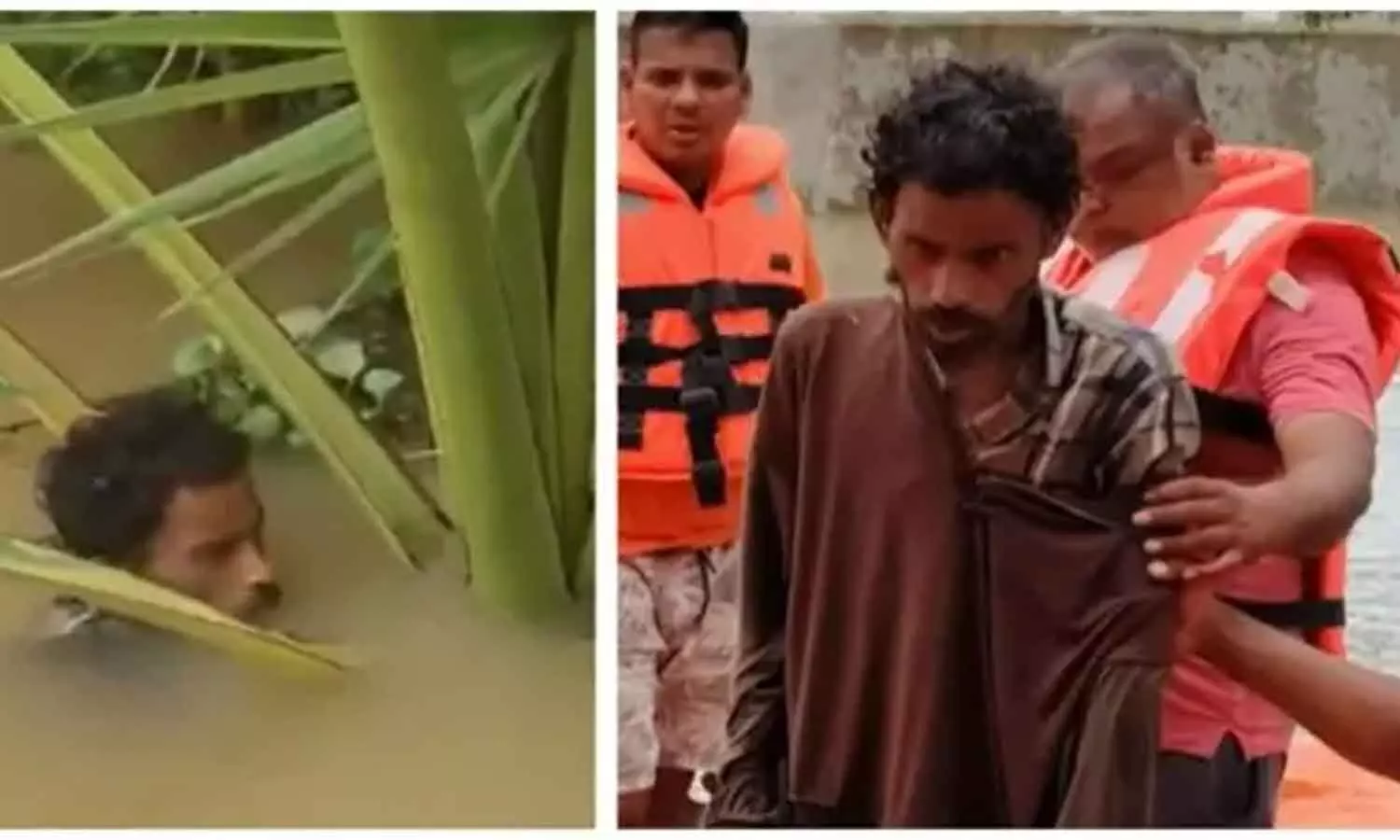
When 35-year-old Sunanda Behera of Odisha’s Bhadrak district was swept away by floodwaters, survival seemed almost impossible. For five days, he remained stranded in a flooded field, clinging to a submerged palm tree until villagers spotted him and alerted the Odisha Disaster Rapid Action Force (ODRAF).
He was found severely weakened, with trembling hands and legs, and was taken to hospital for treatment.
But how can the human body keep functioning when someone is exposed to danger, exhaustion, hunger and prolonged immersion for days?
The answer lies in a complex interaction between the brain, nervous system, hormones, metabolism and behaviour.
What happens when the brain senses danger?
The body’s first response to a life-threatening situation is stress.
The brain rapidly activates systems that prepare a person to fight, flee or freeze. The sympathetic nervous system releases adrenaline, increasing heart rate, directing blood towards muscles and preparing the body for immediate action.
The stress hormone cortisol also becomes part of the response.
For a short-term emergency, these changes can be lifesaving. But when the crisis lasts for hours or days, the body cannot remain in a constant state of high alert without consequences.
Does the brain enter a ‘zombie-like’ survival mode?
The popular idea of “survival mode” suggests that the rational brain switches off and primitive instincts take over. In reality, surviving a prolonged crisis can require planning, memory, judgement and decision-making.
The brain essentially narrows its priorities.
Finding shelter, conserving energy, maintaining a grip and avoiding unnecessary movement can become more important than almost everything else.
That may help explain why people in extreme situations sometimes perform actions that would seem extraordinary under normal circumstances.
What happens when food is unavailable?
After the body’s readily available glucose reserves decline, metabolism begins shifting towards stored energy, including fat.
The liver produces ketones, which can provide an alternative fuel for the brain.
But this adaptation has limits. During prolonged fasting, the body also breaks down muscle tissue. That means someone surviving for several days without adequate food can become progressively weaker.
For a person clinging to a tree, that weakness can be particularly dangerous because the muscles needed to maintain grip and posture are constantly working.
Why can being in water for days be especially dangerous?
Floodwater creates another challenge: temperature regulation.
Water transfers heat much more efficiently than air. Even when the water does not feel extremely cold, prolonged immersion can force the body to expend additional energy maintaining its core temperature.
Immersion can also alter the body’s fluid distribution and cardiovascular function.
For someone stranded in floodwater, therefore, the danger isn’t simply hunger. Exhaustion, dehydration, exposure, muscle fatigue and the risk of losing consciousness can all become critical.
Why doesn’t the body simply ‘run out of energy’ immediately?
The human body has multiple energy systems and can change how it uses available fuel.
In an emergency, non-essential processes are deprioritised while systems needed for immediate survival receive greater attention. As the crisis continues, metabolism changes again to conserve energy.
Think of it as the body entering an increasingly restrictive low-power mode.
But there is no unlimited emergency reserve. Eventually, dehydration, hypothermia, starvation, infection, injury or exhaustion can overwhelm these mechanisms.
What role does the mind play?
Extraordinary survival stories also show that survival isn’t purely physical.
People who have survived extreme situations have often relied on knowledge, memory, observation and decision-making.
Knowing where to find shelter, understanding the environment or simply recognising when to conserve energy can make a major difference.
This is why scientists caution against viewing survival as a single automatic “instinct”. It is better understood as an ongoing interaction between biology and behaviour.
The limits of human survival
Stories of people surviving days or even weeks in extraordinary conditions can create the impression that the human body is almost limitless.
It isn’t.
There is no guaranteed biological “survival mode” that can protect everyone from extreme conditions. Every situation depends on factors such as access to water, temperature, injuries, physical condition, energy expenditure and the surrounding environment.
Sunanda Behera’s five-day ordeal therefore isn’t evidence that humans can simply withstand anything. Instead, it demonstrates how remarkably adaptable the human body and brain can be while still operating within very real biological limits.
His rescue also highlights another crucial factor in survival: being found in time. In many extreme situations, the difference between survival and death may ultimately depend not only on what the body can endure, but on whether help arrives before those limits are reached.